
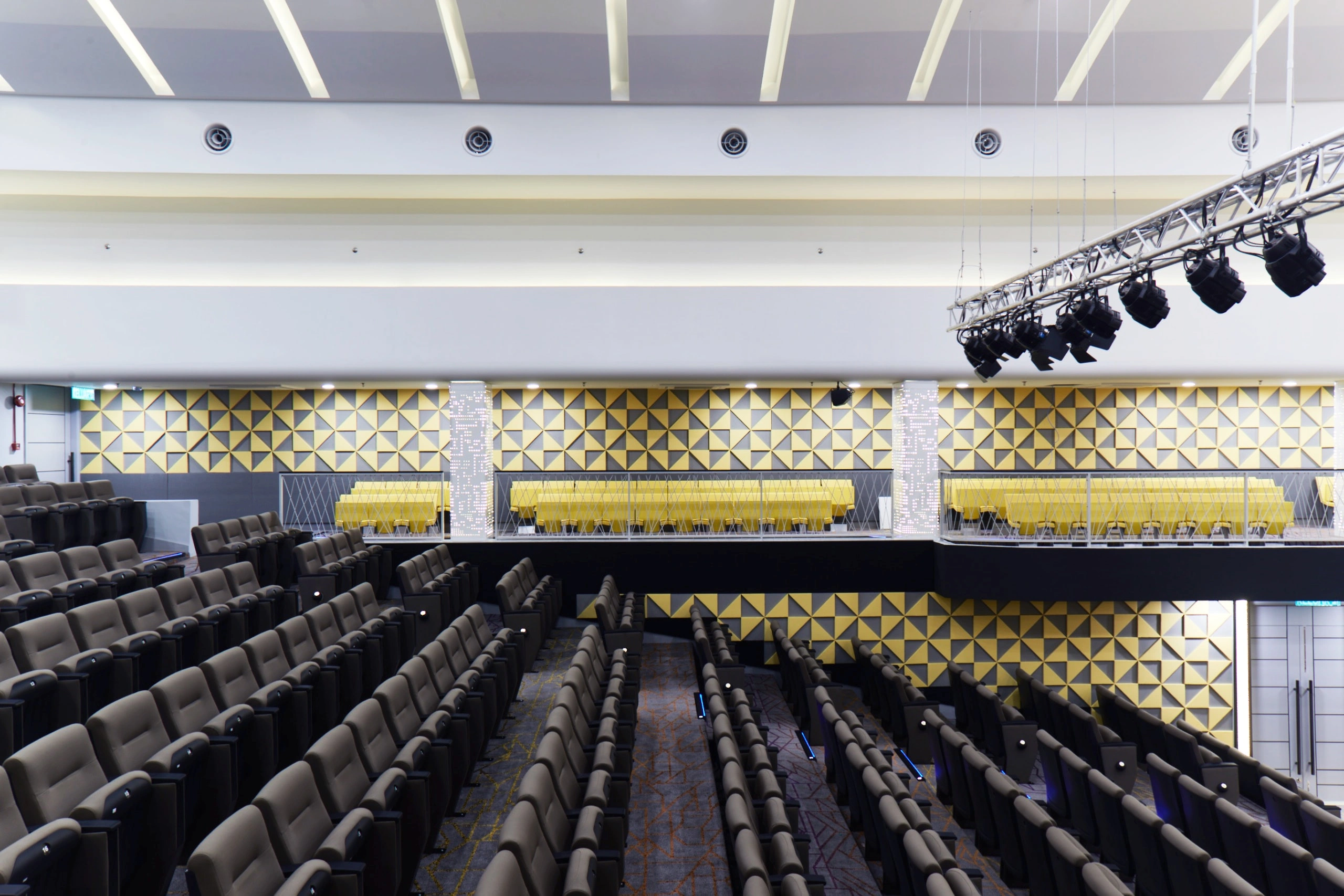
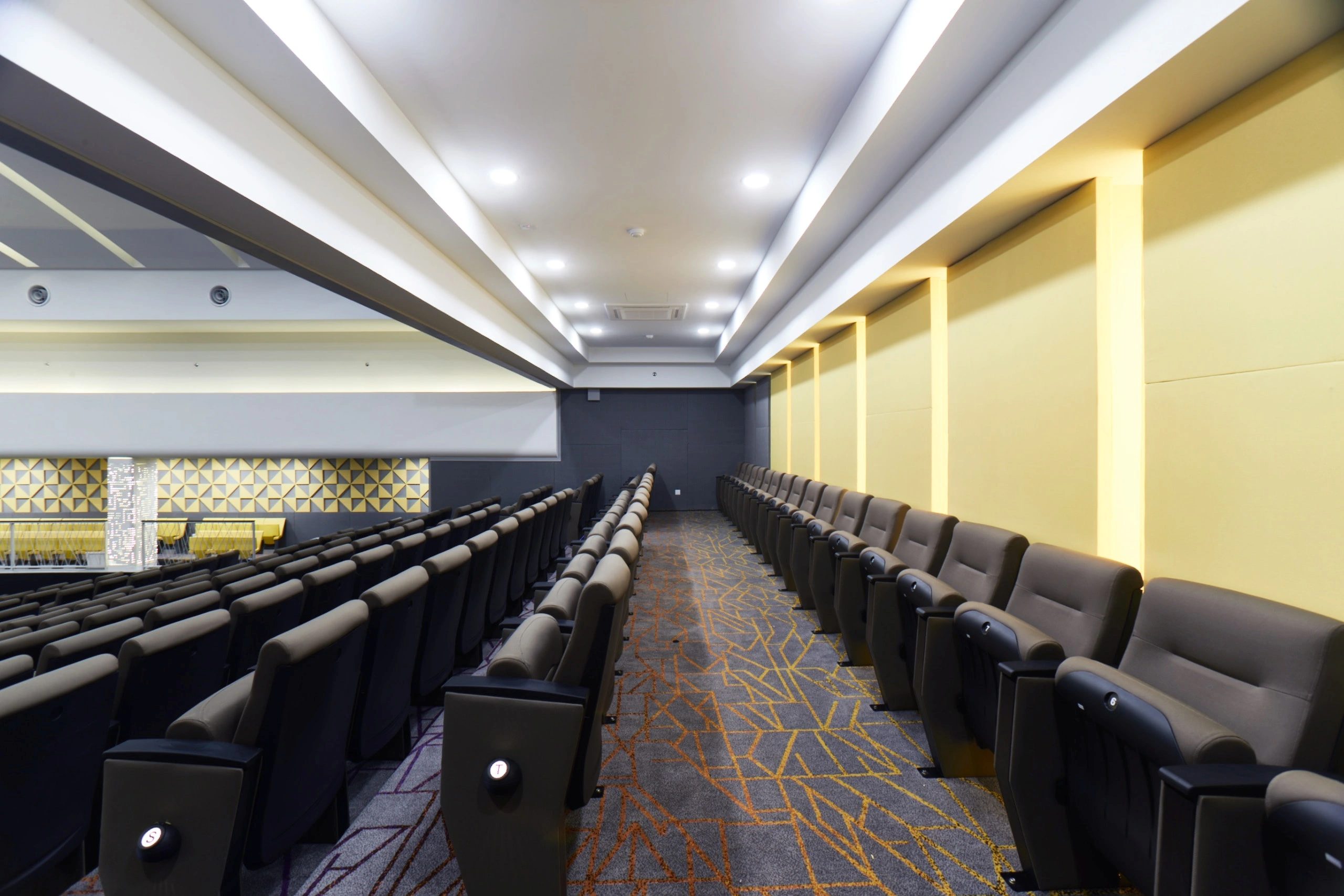
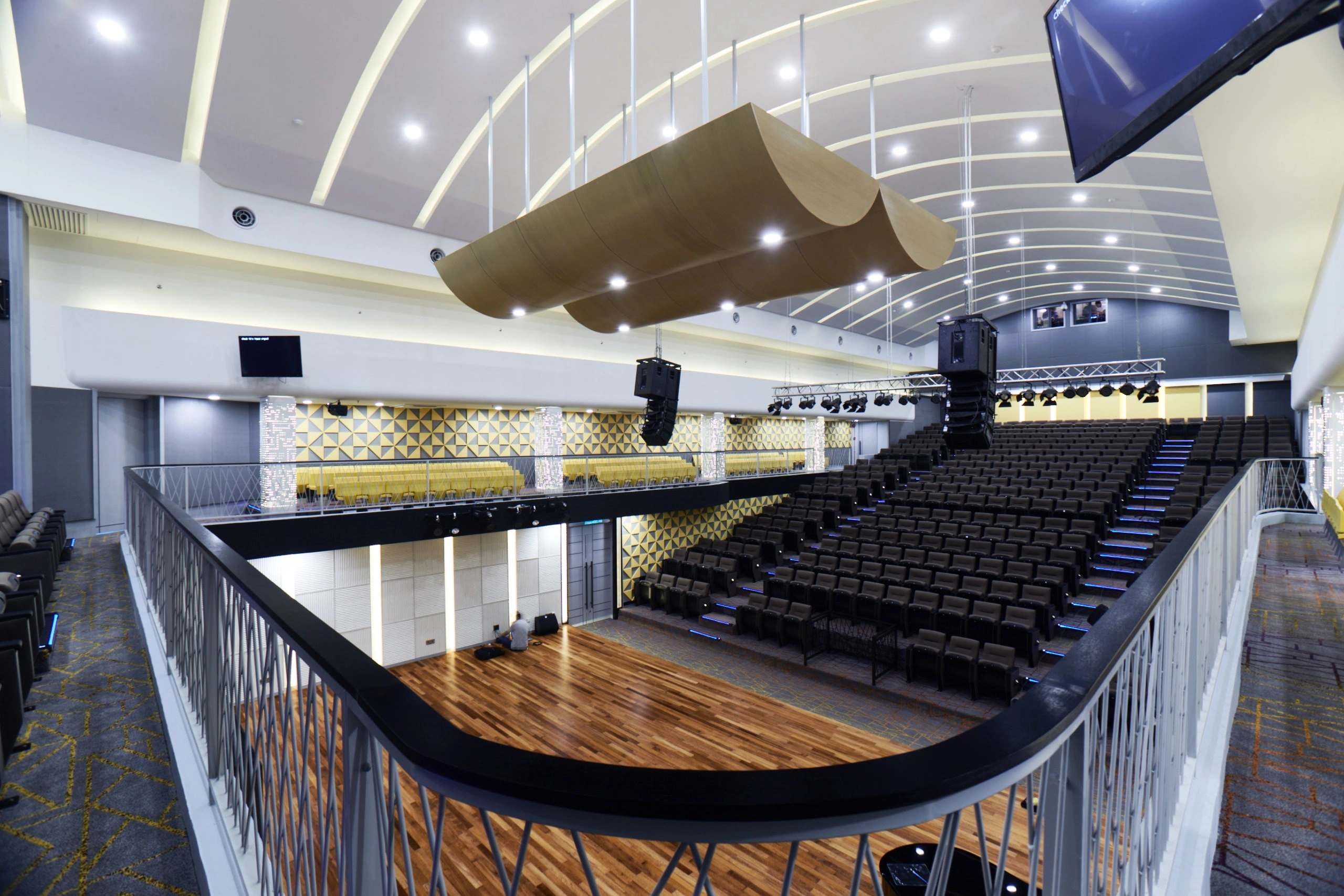
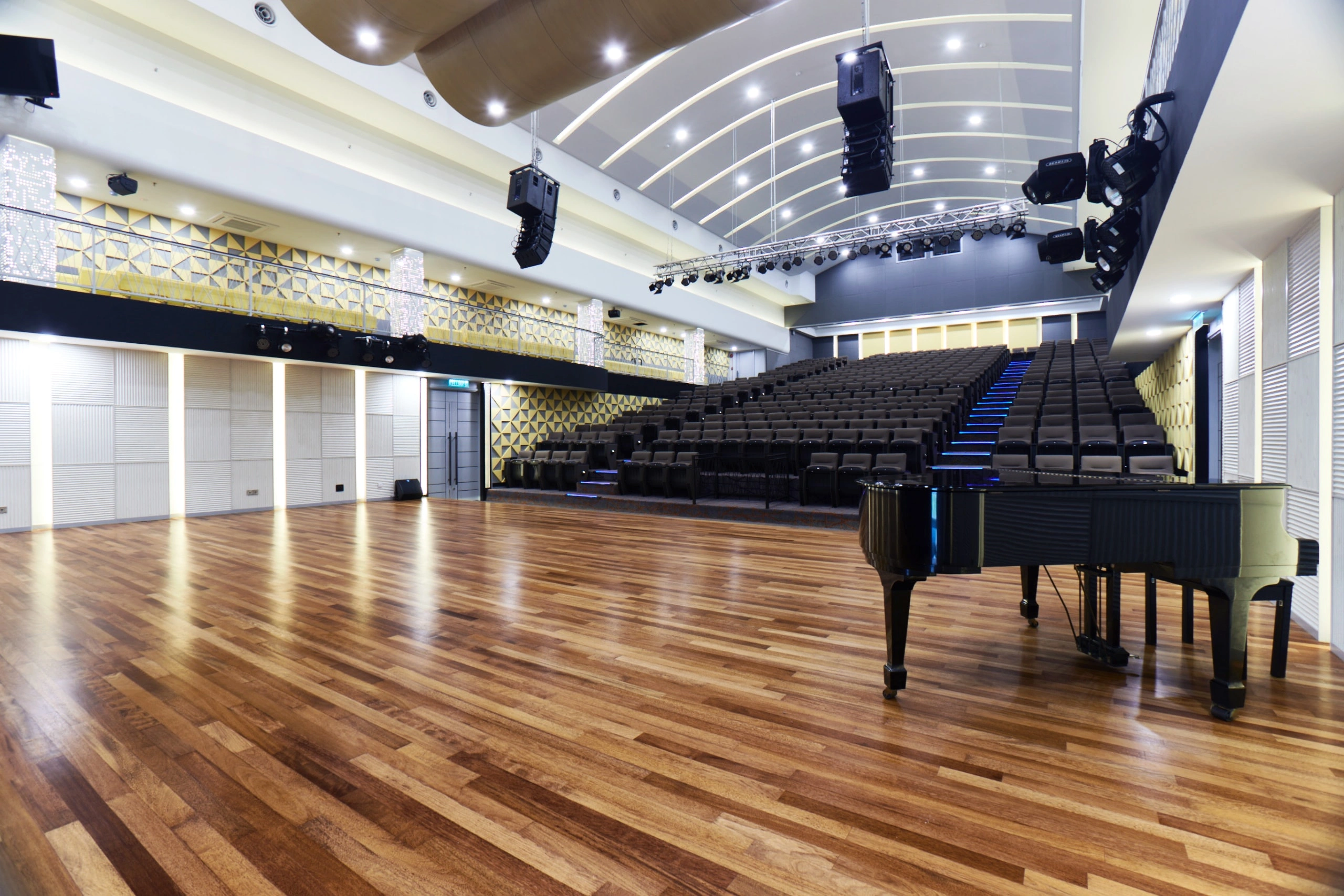
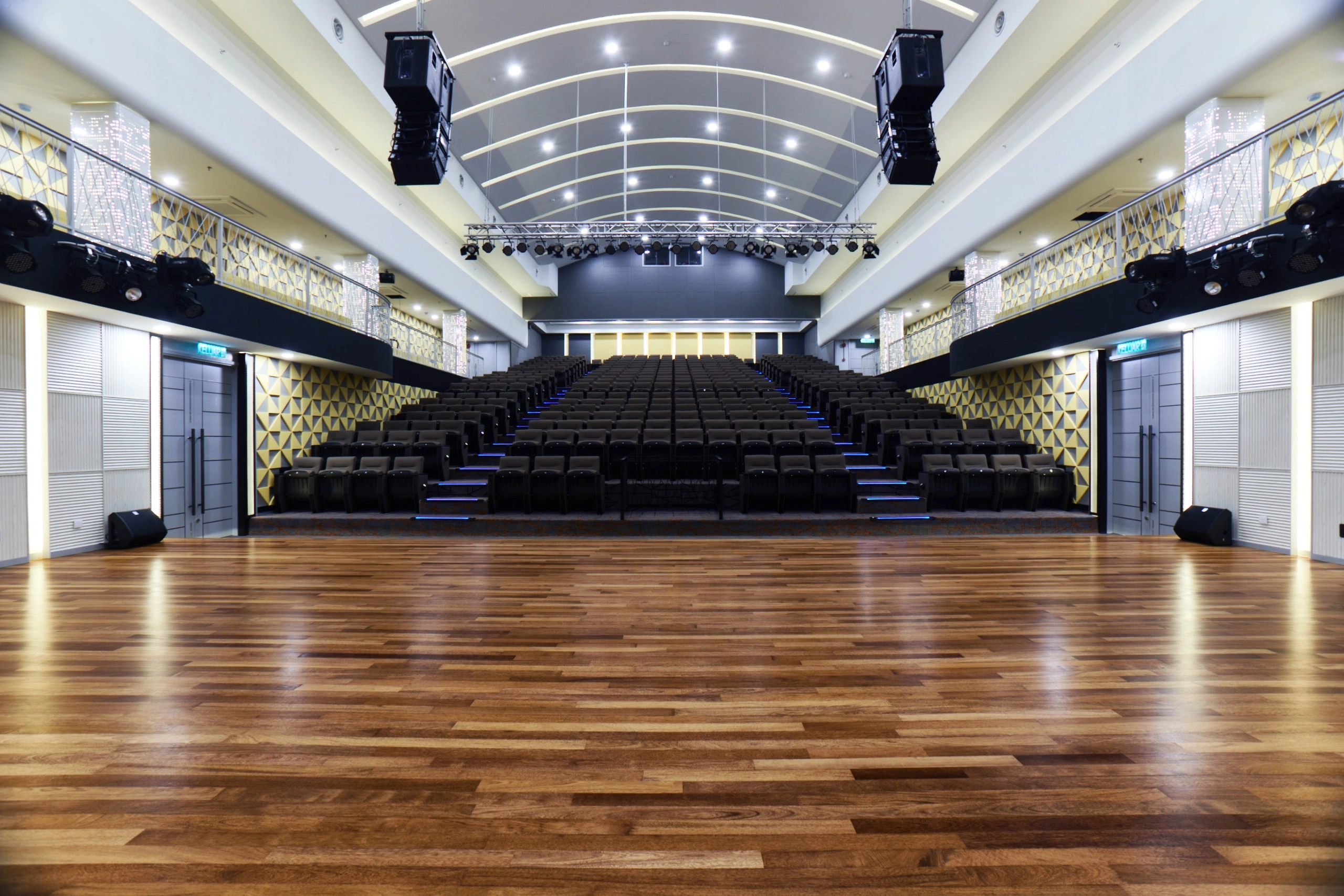
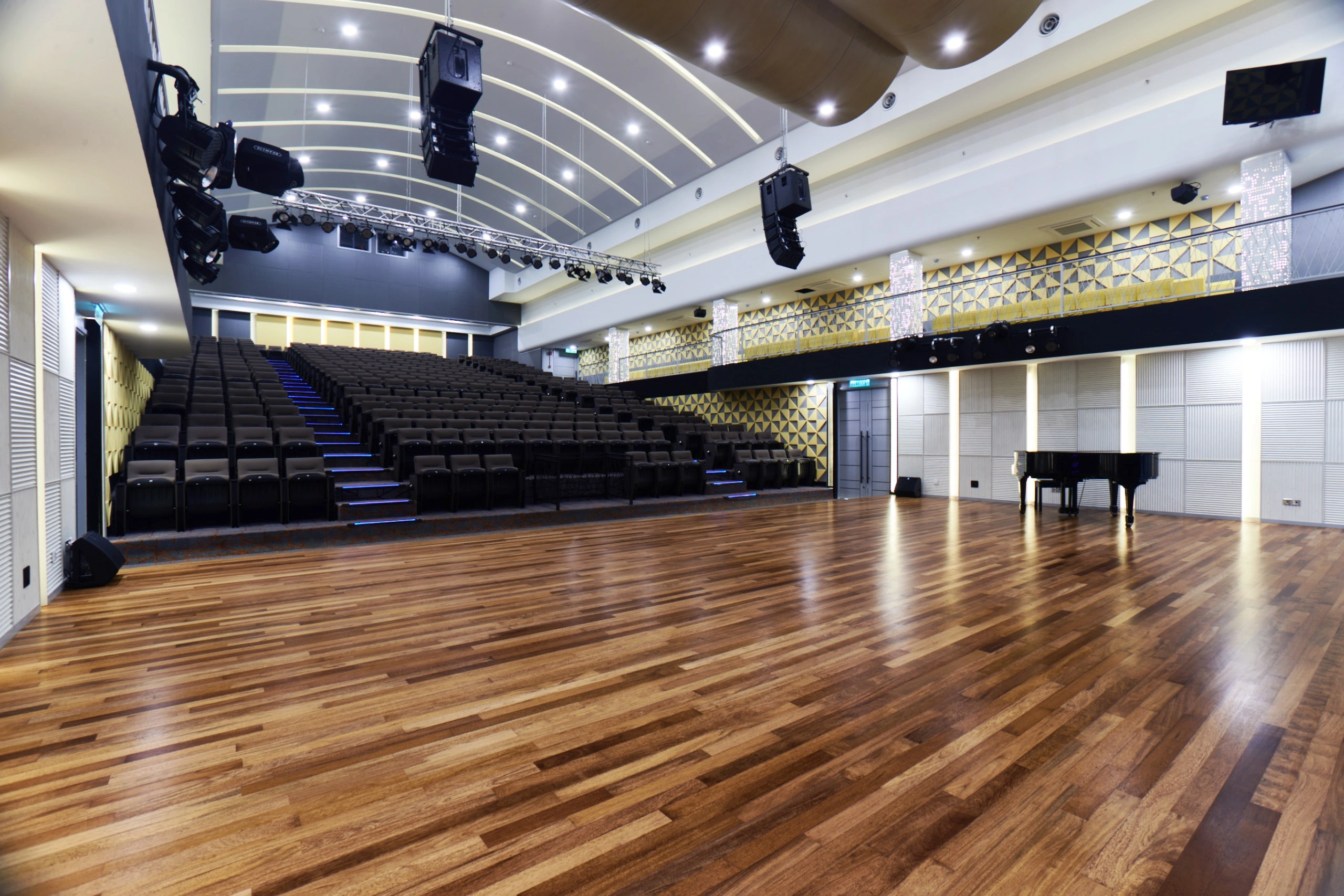
Introduction: The Art and Science of Auditorium Acoustics
Auditorium acoustic design represents one of the most sophisticated challenges in architectural acoustics, requiring a delicate balance between speech intelligibility, musical warmth, spatial impression, and audience engagement. Unlike specialized performance venues designed for a single purpose, auditoriums typically serve multiple functions—from theatrical productions and orchestral performances to lectures, corporate presentations, and community gatherings.
Consequently, successful auditorium acoustic design demands comprehensive understanding of psychoacoustic principles, rigorous adherence to international standards, and masterful integration of acoustic materials with architectural vision. Furthermore, modern auditoriums must seamlessly incorporate sophisticated electro-acoustic systems while preserving the intimacy and naturalness that define exceptional acoustic spaces.
This comprehensive guide examines auditorium acoustic design from fundamental principles through practical implementation, providing architects, acoustic consultants, theater designers, and facility planners with actionable strategies for creating world-class performance environments.
Part One: Understanding Auditorium Acoustic Fundamentals
1.1 Core Acoustic Philosophy for Auditoriums
Unlike conference halls where speech clarity reigns supreme, auditoriums must simultaneously address multiple acoustic objectives. Specifically, these facilities require:
Exceptional Speech Intelligibility: Every spoken word must reach audiences with clarity, particularly in educational and lecture contexts. Moreover, theatrical dialogue demands nuanced delivery that conveys emotional subtlety beyond mere comprehension.
Musical Richness and Warmth: Conversely, musical performances benefit from controlled reverberation that enhances tonal beauty, creates spatial envelopment, and supports harmonic development. As a result, the acoustic environment must adapt to varying artistic requirements.
Spatial Impression and Envelopment: Additionally, audiences should experience appropriate spatial impression—the perception of being surrounded by sound—which significantly enhances emotional connection to performances.
Intimacy Despite Scale: Furthermore, even large auditoriums must maintain acoustic intimacy, ensuring that audiences feel personally connected to performers rather than isolated in vast spaces.
1.2 Seven Critical Design Challenges
Multi-Purpose Performance Requirements: First and foremost, auditoriums typically accommodate diverse programs ranging from amplified rock concerts to unamplified chamber music, from spoken word performances to full orchestral presentations. Consequently, the acoustic environment must either adapt to these varying needs or provide acceptable compromise across all uses.
Balancing Reverberation for Different Programs: Additionally, speech-focused events benefit from short reverberation times (0.8-1.2 seconds), whereas orchestral music thrives with longer reverberation (1.6-2.2 seconds). Therefore, designers face the challenge of either providing variable acoustics or optimizing for primary usage.
Ensuring Uniform Coverage Across Seating Areas: Moreover, all audience members deserve equivalent acoustic experience regardless of seating location. Nevertheless, achieving uniform sound distribution in large, multi-tiered auditoriums presents significant technical challenges.
Controlling Acoustic Defects in Large Volumes: Similarly, large auditoriums are particularly susceptible to echoes, sound focusing, and dead spots that compromise acoustic quality. Indeed, even minor geometric irregularities can create troublesome acoustic phenomena.
Integrating Sound Reinforcement Naturally: In addition, many contemporary performances require electro-acoustic support, yet sound systems must enhance rather than dominate the natural acoustic environment. Thus, architectural acoustics must create favorable conditions for sound reinforcement while maintaining acoustic integrity.
Achieving Adequate Sound Isolation: Furthermore, auditoriums require exceptional sound isolation from external noise sources and adjacent spaces to maintain artistic atmosphere and prevent distraction. Particularly in urban locations, controlling traffic, aircraft, and mechanical system noise becomes paramount.
Managing Background Noise from Building Systems: Finally, HVAC systems, lighting equipment, and other building services must operate virtually silently to avoid masking quiet musical passages or distracting from intimate theatrical moments.
Part Two: Acoustic Performance Objectives
2.1 Comprehensive Performance Criteria
Successful auditorium acoustic design must simultaneously satisfy eight critical performance objectives, each contributing to overall acoustic excellence:
Reverberation Time Optimization: Primarily, reverberation time must support the auditorium’s primary function while remaining acceptable for secondary uses. Specifically, this involves careful balancing of absorptive and reflective surfaces throughout the space.
Early Reflection Management: Subsequently, early reflections arriving within 50 milliseconds of direct sound strengthen clarity and fullness. Therefore, strategic placement of reflective surfaces enhances acoustic support for both speech and music.
Clarity and Definition Preservation: Concurrently, sufficient early-to-late sound energy ratio ensures that individual notes, words, and musical phrases remain distinct rather than blurred by excessive reverberation.
Bass Response and Warmth: Meanwhile, low-frequency reverberation and resonance contribute musical warmth and fullness. However, excessive bass buildup creates muddiness and reduces clarity.
Spatial Impression Creation: In parallel, lateral reflections from side walls create the spatial envelopment that makes performances feel immersive and engaging rather than flat and distant.
Background Noise Suppression: Simultaneously, ambient noise must remain sufficiently low to allow appreciation of pianissimo musical passages and subtle theatrical moments.
Acoustic Defect Elimination: Additionally, all forms of acoustic defects—including echoes, flutter, focusing, and dead spots—must be identified and corrected during design development.
Sound Distribution Uniformity: Ultimately, these objectives must be achieved uniformly throughout the audience area, ensuring equitable acoustic experience for all patrons.
2.2 Performance Priority Framework
When design constraints limit full achievement of all objectives, the following priority framework guides decision-making:
Table 1: Acoustic Objective Priority Matrix
| Priority Level | Objective | Rationale | Compromise Tolerance |
|---|---|---|---|
| Tier 1 – Essential | Reverberation time appropriate for primary use | Fundamentally determines acoustic character | No compromise acceptable |
| Tier 1 – Essential | Complete elimination of acoustic defects | Defects create unacceptable quality issues | No compromise acceptable |
| Tier 1 – Essential | Background noise control to target levels | Excessive noise ruins quiet passages | Minimal compromise (5 NC points) |
| Tier 2 – Critical | Clarity/intelligibility metrics (C80/STI) | Directly impacts audience comprehension | Moderate compromise acceptable |
| Tier 2 – Critical | Sound level uniformity across seating | Ensures equitable audience experience | ±3 dB variation acceptable |
| Tier 3 – Important | Bass warmth and low-frequency response | Enhances musical quality | Some compromise acceptable |
| Tier 3 – Important | Spatial impression and envelopment | Improves emotional engagement | Moderate compromise acceptable |
| Tier 4 – Desirable | Visual integration of acoustic elements | Aesthetic considerations | Significant compromise acceptable |
Part Three: International Standards and Guidelines
3.1 Primary Acoustic Standards
To begin with, numerous international and national standards govern auditorium acoustic design. Consequently, designers must understand which standards apply to specific project types and jurisdictions.
ISO 3382-1: Acoustics — Measurement of Room Acoustic Parameters: Notably, this standard defines measurement methods for reverberation time, early decay time, clarity, and other parameters in performance spaces. Furthermore, it establishes standardized positions for measurements and calculation procedures.
IEC 60268-16: Sound System Equipment — Objective Rating of Speech Intelligibility: Additionally, this standard specifies STI measurement procedures, particularly relevant for speech-oriented auditorium uses.
ISO 9613: Acoustics — Attenuation of Sound During Propagation Outdoors: Moreover, for auditoriums with potential outdoor noise intrusion, this standard provides calculation methods for predicting external noise levels.
DIN 18041: Acoustic Quality in Rooms: Similarly, this German standard offers detailed guidance for various room types including auditoriums, specifying target reverberation times based on room volume and usage.
3.2 National and Regional Standards
Table 2: Key National Acoustic Standards by Region
| Region/Country | Standard Code | Standard Title | Primary Focus Areas |
|---|---|---|---|
| China | GB/T 50356 | Code for Acoustic Design of Theatre, Cinema and Multi-Purpose Hall | Comprehensive auditorium design requirements |
| China | GB 50118 | Code for Sound Insulation Design of Civil Buildings | Sound isolation requirements |
| United States | ANSI S12.60 | Acoustical Performance Criteria, Design Requirements, and Guidelines | Background noise and reverberation limits |
| Europe | EN 12354 | Building Acoustics – Estimation of Acoustic Performance | Prediction methods for acoustic performance |
| United Kingdom | BB93 | Acoustic Design of Schools | Educational auditorium guidance |
| Australia/NZ | AS/NZS 2107 | Acoustics – Recommended Design Sound Levels | Background noise recommendations |
3.3 Industry Best Practice Guidelines
In addition to formal standards, several organizations provide valuable best practice guidance:
Acoustical Society of America (ASA): Publishes research and recommendations on concert hall and theater acoustics based on ongoing scientific investigation.
International Organization for Standardization (ISO): Beyond formal standards, ISO technical committees develop guidance documents addressing emerging acoustic topics.
Theatre Projects Consultants: Industry-leading firms have established internal standards often exceeding published requirements, based on decades of successful project experience.
Green Building Rating Systems: Meanwhile, LEED, WELL, and other sustainability frameworks increasingly incorporate acoustic quality criteria that influence auditorium design.
Part Four: Critical Acoustic Performance Metrics
4.1 Reverberation Time Specifications
Above all, reverberation time remains the single most influential parameter determining auditorium acoustic character. Nevertheless, optimal values vary significantly based on auditorium volume, primary usage, and architectural preferences.
Table 3: Recommended Reverberation Time by Auditorium Type and Volume
| Auditorium Type | Volume Range | Recommended RT60 (500-1000 Hz) | Primary Usage | Design Considerations |
|---|---|---|---|---|
| Small Multi-Purpose | 1,000-3,000 m³ | 1.0-1.4 seconds | Lectures, small performances, meetings | Versatility prioritized; slightly dead for speech clarity |
| Medium Theater | 3,000-8,000 m³ | 1.2-1.6 seconds | Drama, musical theater, presentations | Balanced for both speech and amplified music |
| Large Concert Hall | 8,000-20,000 m³ | 1.8-2.2 seconds | Orchestral music, choral performances | Longer RT enhances musical warmth and blend |
| Opera House | 10,000-25,000 m³ | 1.4-1.8 seconds | Opera, ballet with live orchestra | Compromise between vocal clarity and orchestral warmth |
| Recital Hall | 500-2,000 m³ | 1.3-1.7 seconds | Chamber music, solo performances | Intimacy with sufficient reverberant support |
| Lecture Hall/Auditorium | 2,000-10,000 m³ | 0.8-1.2 seconds | Educational lectures, presentations | Speech intelligibility paramount |
Frequency-Dependent Characteristics: Furthermore, reverberation time should exhibit appropriate frequency dependency. Specifically, low-frequency reverberation (125-250 Hz) typically measures 10-30% longer than mid-frequencies, providing bass warmth. Conversely, high-frequency reverberation (2000-4000 Hz) should remain within ±10% of mid-frequency values to maintain clarity.
Occupancy Variations: Additionally, designers must account for significant reverberation changes between empty and occupied conditions. Generally, full occupancy reduces reverberation by 20-30% compared to empty halls. Therefore, design targets typically reference half-occupied or occupied conditions for primary use events.
4.2 Clarity and Intelligibility Metrics
Beyond reverberation time, several metrics quantify the balance between early (useful) and late (potentially detrimental) sound energy.
Table 4: Clarity and Intelligibility Standards by Usage Type
| Usage Type | C80 (Clarity) | C50 (Definition) | STI (Speech Transmission Index) | D50 (Deutlichkeit) | Application Context |
|---|---|---|---|---|---|
| Orchestral Music | -2 to +2 dB | Not critical | Not applicable | Not critical | Balance between clarity and reverberance |
| Chamber Music | +1 to +4 dB | Not critical | Not applicable | 0.55-0.65 | Slightly higher clarity than orchestral |
| Opera/Musical Theater | 0 to +3 dB | ≥ 0 dB | ≥ 0.60 | 0.60-0.70 | Balance vocal clarity with musical support |
| Drama/Theater | +2 to +5 dB | +2 to +5 dB | ≥ 0.65 | ≥ 0.70 | Strong emphasis on speech intelligibility |
| Lectures/Presentations | ≥ +4 dB | ≥ +4 dB | ≥ 0.70 | ≥ 0.75 | Maximum speech clarity required |
| Multi-Purpose | 0 to +3 dB | +1 to +3 dB | ≥ 0.60 | 0.60-0.70 | Compromise across diverse uses |
Measurement Positions: Importantly, these metrics should be evaluated at multiple representative audience positions, particularly including:
- Front orchestra/stalls seating
- Mid-orchestra central positions
- Rear orchestra seating
- Balcony front rows
- Balcony rear positions
- Side box seats (if applicable)
4.3 Early Reflection and Support Metrics
Equally important, early reflections significantly influence perceived clarity, intimacy, and sound quality.
Table 5: Early Reflection Performance Targets
| Parameter | Symbol | Target Range | Purpose | Measurement Notes |
|---|---|---|---|---|
| Early Decay Time | EDT | 0.9-1.1 × RT60 | Sound field uniformity indicator | Should closely match RT60 throughout room |
| Initial Time Delay Gap | ITDG | 15-35 ms | Intimacy perception | Time between direct sound and first strong reflection |
| Lateral Fraction | LF | 0.15-0.35 | Spatial impression and envelopment | Ratio of lateral to total early sound energy |
| Sound Strength | G | +3 to +6 dB | Acoustic support for performers | Relative sound level compared to reference space |
| Stage Support | ST1, ST2 | -12 to -18 dB | Ensemble communication | Early and late stage reflections for musicians |
4.4 Background Noise Standards
Similarly, background noise profoundly impacts acoustic experience, particularly during quiet musical passages or dramatic moments.
Table 6: Maximum Background Noise Levels by Auditorium Type
| Auditorium Type | Maximum NC Rating | Maximum NR Rating | Maximum dBA | Critical Considerations |
|---|---|---|---|---|
| Concert Hall | NC 15-20 | NR 15-20 | 25-30 dBA | Essential for appreciating pianissimo passages |
| Opera House | NC 20-25 | NR 20-25 | 30-33 dBA | Quiet enough for unamplified singing |
| Drama Theater | NC 25-30 | NR 25-30 | 33-38 dBA | Supports intimate theatrical moments |
| Musical Theater | NC 25-30 | NR 25-30 | 33-38 dBA | Amplification provides some noise masking |
| Multi-Purpose Hall | NC 25-30 | NR 25-30 | 33-38 dBA | Compromise for diverse uses |
| Lecture Auditorium | NC 30-35 | NR 30-35 | 38-42 dBA | Speech focus; some tolerance for noise |
| Cinema | NC 30-35 | NR 30-35 | 38-42 dBA | Film soundtracks mask moderate noise |
Noise Source Hierarchy: Furthermore, background noise typically originates from:
- HVAC systems (most common source)
- External environmental noise (traffic, aircraft)
- Adjacent building activities
- Building equipment (elevators, transformers)
- Audience self-noise (minimum achievable level)
4.5 Sound Isolation Requirements
Additionally, sound isolation prevents external noise intrusion and contains auditorium sound from disturbing adjacent spaces.
Table 7: Sound Transmission Class (STC) and Impact Insulation Class (IIC) Requirements
| Separation Type | Minimum STC | Recommended STC | Minimum IIC | Application |
|---|---|---|---|---|
| Auditorium to Exterior | STC 55 | STC 60-70 | N/A | Depends on external noise environment |
| Auditorium to Adjacent Auditorium | STC 60 | STC 65-70 | IIC 60 | Prevents simultaneous performance interference |
| Auditorium to Lobby/Circulation | STC 50 | STC 55-60 | IIC 50 | Contains performance sound; prevents lobby noise intrusion |
| Auditorium to Support Spaces | STC 55 | STC 60-65 | IIC 55 | Backstage, dressing rooms, workshops |
| Stage to Audience | None | N/A | N/A | Acoustic connection required |
| Fly Loft to Audience | STC 45 | STC 50-55 | IIC 50 | Minimize rigging and equipment noise |
Part Five: Architectural Acoustic Design Strategies
5.1 Room Shape and Geometry Optimization
First and foremost, auditorium geometry profoundly influences acoustic performance. Consequently, optimal room shape balances acoustic objectives with functional requirements, sightline constraints, and architectural expression.
Traditional Shoebox Configuration: Historically, rectangular halls with parallel side walls have proven highly successful for concert performances. Specifically, this geometry:
- Provides strong lateral reflections enhancing spatial impression
- Creates uniform sound distribution through multiple reflection paths
- Supports bass response through favorable room mode distribution
- Facilitates natural acoustic balance without complex interventions
Nevertheless, shoebox halls can suffer from flutter echo between parallel walls unless appropriately treated with diffusion or absorption.
Fan-Shaped Plans: Alternatively, fan-shaped auditoriums maximize seating capacity within constrained depths while maintaining acceptable sightlines. However, this configuration:
- Reduces lateral reflection strength as walls diverge
- May create focusing effects if wall curvature is inappropriate
- Often requires supplementary reflective surfaces for acoustic support
- Benefits from careful acoustic modeling during design development
Vineyard or Surround Configurations: In contrast, vineyard-style halls place seating surrounding or partially surrounding the performance area. As a result:
- Visual intimacy increases dramatically
- Acoustic intimacy may improve through reduced performer-audience distance
- Cross-hall reflections create complex early reflection patterns
- Requires sophisticated reflector systems for consistent sound distribution
Horseshoe and Lyric Theater Forms: Similarly, traditional opera houses employ horseshoe shapes with multiple balcony levels. Consequently:
- Social and visual hierarchy becomes architecturally expressed
- Box seats create favorable early reflection patterns
- Deep balcony overhangs risk acoustic shadowing requiring careful design
- Proscenium arch focuses attention while providing acoustic boundary
5.2 Ceiling Design and Reflector Systems
Subsequently, ceiling configuration represents one of the most powerful tools for acoustic control, simultaneously influencing reverberation time, early reflections, and sound distribution.
Reflective Ceiling Strategies: Primarily, shaped ceiling reflectors can:
- Direct sound energy toward specific seating areas requiring reinforcement
- Create favorable early reflections supporting clarity and fullness
- Compensate for geometric challenges in fan-shaped or wide halls
- Provide visual interest while serving acoustic function
Ceiling Height Considerations: Moreover, ceiling height profoundly impacts acoustic character:
Table 8: Ceiling Height Recommendations by Auditorium Type
| Auditorium Type | Minimum Height (to lowest point) | Optimal Height Range | Maximum Recommended | Acoustic Rationale |
|---|---|---|---|---|
| Intimate Recital Hall | 5.5 m | 6-8 m | 10 m | Lower ceilings enhance intimacy and clarity |
| Drama Theater | 8 m | 9-12 m | 15 m | Moderate height balances clarity with volume |
| Concert Hall | 12 m | 14-20 m | 25 m | Greater height provides reverberant volume |
| Opera House | 15 m | 18-25 m | 30 m | High fly loft required; impacts acoustics |
| Multi-Purpose Hall | 10 m | 12-16 m | 20 m | Compromise across various uses |
Suspended Reflector Arrays: Furthermore, individual suspended reflectors or “clouds” offer several advantages:
- Adjustable positioning for different performance configurations
- Targeted early reflection control
- Visually dynamic architectural expression
- Maintenance access to ceiling systems above
5.3 Wall Treatment Strategies
In parallel, wall surface treatment balances absorption, reflection, and diffusion to achieve target acoustic characteristics.
Front Wall (Behind Stage/Performance Area): Initially, front wall treatment should:
- Provide diffusion rather than specular reflection to scatter sound
- Avoid strong reflections returning to performer microphone positions
- Support stage acoustics through appropriately angled surfaces
- Integrate architectural elements (organ cases, decorative panels) with acoustic function
Side Wall Treatment Zones:
Table 9: Side Wall Acoustic Treatment Strategy
| Wall Zone | Distance from Stage | Primary Treatment | Acoustic Function | Typical Materials |
|---|---|---|---|---|
| Front Zone | 0-8 m | Reflective with diffusion | Early lateral reflections for spatial impression | Wood panels, diffusive elements |
| Middle Zone | 8-20 m | Mixed reflective/absorptive | Balance reverberation while maintaining some reflection | Combination panels, variable acoustics |
| Rear Zone | >20 m | Primarily absorptive | Control reverberation, prevent long-delay echoes | Fabric-wrapped panels, thick absorption |
| Upper Walls | Above seating | Absorptive or diffusive | Reduce ceiling-wall flutter, control volume | Acoustic panels, architectural diffusers |
Rear Wall Treatment: Subsequently, rear walls require special attention:
- Maximum absorption (NRC ≥ 0.90) to eliminate echoes
- Sufficient thickness (150-300mm) for low-frequency absorption
- Aesthetic integration often challenging given thickness requirements
- May incorporate sound lock entries behind absorptive wall treatment
5.4 Audience Seating Area Design
Concurrently, seating area configuration significantly influences acoustic performance beyond simple absorption contribution.
Seating Rake and Sightlines: Primarily, upward seating rake provides both visual and acoustic benefits:
- Reduces sound absorption by intervening audience heads
- Improves line-of-sight between performers and listeners
- Enhances sense of intimacy despite physical distance
- Typical rake varies from 0.08-0.15 m per row
Balcony Design: Additionally, balconies require careful acoustic consideration:
Table 10: Balcony Design Acoustic Guidelines
| Parameter | Guideline Value | Acoustic Impact | Design Implications |
|---|---|---|---|
| Maximum Overhang Depth | 2× ceiling height beneath | Prevents acoustic shadowing | Limits balcony projection |
| Soffit Treatment | Highly absorptive (NRC ≥ 0.85) | Reduces balcony rear wall reflections | Absorptive panels or fabric systems |
| Front Face Treatment | Reflective or diffusive | Provides early reflections to orchestra | Wood, plaster, or diffusive elements |
| Rake Angle | Steeper than orchestra | Improves sightlines over balcony front | Structural and accessibility implications |
5.5 Stage and Performance Area Acoustics
Furthermore, stage acoustics profoundly affect performer experience, ensemble communication, and ultimately audience perception.
Stage Enclosure Design: Primarily, the stage enclosure must:
- Provide sufficient early reflections for performer self-hearing
- Enable ensemble communication across instrumental sections
- Support rather than amplify or attenuate sound projection to audience
- Accommodate variable configurations for different performance types
Orchestra Shell Systems: Consequently, adjustable orchestra shells serve multiple functions:
Table 11: Orchestra Shell Performance Requirements
| Shell Component | Acoustic Function | Adjustability | Material Recommendations |
|---|---|---|---|
| Ceiling Panels | Reflect sound to performers and front audience | Height-adjustable (often 6-10m) | Heavy plywood or composite (25-40mm thick) |
| Rear Wall | Contains sound, provides bass support | Sometimes removable or foldable | Massive construction, may include absorption |
| Side Walls/Wings | Lateral reflections for ensemble, projection | Angle-adjustable | Moderate mass with reflective inner surface |
| Side Wall Extension | Extended configuration for larger ensembles | Removable sections | Matching side wall construction |
Stage Flooring: Additionally, stage floor construction impacts acoustic performance:
- Timber construction (typically 25-40mm tongue-and-groove over sleepers) provides optimal acoustic response
- Concrete stages often sound dead and unsupportive unless specially treated
- Removable stage sections enable conversion between configurations
- Appropriate resilience supports musical tone production without excessive energy absorption
Part Six: Sound Isolation and Noise Control
6.1 Building Envelope Sound Isolation
Initially, exterior wall and roof assemblies must provide adequate isolation from environmental noise while supporting internal acoustic requirements.
Wall Construction Options:
Table 12: Exterior Wall Sound Isolation Strategies
| Construction Type | Typical STC | Application Context | Advantages | Limitations |
|---|---|---|---|---|
| Single-Wythe Masonry | STC 45-50 | Low-noise environments | Cost-effective, simple | Limited isolation |
| Cavity Wall (Double-Wythe) | STC 55-60 | Moderate noise | Good isolation, proven | Requires significant thickness |
| Independent Stud Walls | STC 60-65 | Urban locations | Excellent isolation | Complex detailing required |
| Room-Within-Room | STC 70+ | Extreme noise (airports, rail) | Maximum isolation | Costly, space-intensive |
Roof Assembly Considerations: Similarly, roof construction must address:
- Aircraft noise in flight path locations
- Rain noise (particularly problematic for metal roofs)
- HVAC equipment isolation from performance spaces below
- Acoustic ceiling systems contributing to overall isolation
6.2 Internal Partition Sound Isolation
Subsequently, partitions separating auditorium from adjacent spaces require careful design to prevent noise intrusion and sound leakage.
Lobby and Circulation Separation: Particularly, auditorium-lobby partitions must:
- Prevent audience entry/exit noise from disturbing performances
- Contain performance sound from dominating lobby spaces
- Accommodate necessary door openings while maintaining isolation
- Integrate architectural expression with acoustic function
Support Space Separation: Additionally, backstage, dressing rooms, and workshop areas require:
- Adequate isolation from performance spaces (STC 55-60)
- Consideration of impact noise from scene shifting and construction
- Vibration isolation for machinery and equipment
- Acoustic treatment within spaces to control internal reverberation
6.3 HVAC System Noise Control
Moreover, mechanical systems represent the predominant background noise source in most auditoriums. Consequently, comprehensive noise control strategies must address:
System Design Philosophy:
Table 13: HVAC Noise Control Strategy Hierarchy
| Control Tier | Strategy | Implementation | Effectiveness | Cost Impact |
|---|---|---|---|---|
| Tier 1 – Source | Select ultra-quiet equipment | Oversized, slow-speed fans and equipment | Highly effective | Moderate |
| Tier 2 – Path | Generous duct sizing, low velocities | Large ducts, <5 m/s velocity | Very effective | Moderate-High |
| Tier 3 – Treatment | Sound attenuators and duct lining | Silencers at strategic locations | Effective | Moderate |
| Tier 4 – Isolation | Vibration isolation, flexible connections | Isolated equipment, resilient mounts | Effective for vibration | Low-Moderate |
| Tier 5 – Diffuser | Careful diffuser selection and placement | Low-NC diffusers, away from critical zones | Moderately effective | Low |
Critical Design Parameters:
- Maximum supply air velocity: 4-5 m/s in ducts, 2-3 m/s at terminal devices
- Silencer insertion loss: typically 15-25 dB at critical frequencies
- Minimum duct lining: 25mm thickness in main supply and return ducts
- Equipment vibration isolation: 95%+ efficiency at operating frequencies
6.4 Specialized Isolation Considerations
Stage Machinery and Rigging: Furthermore, theatrical auditoriums require additional consideration for:
- Counterweight systems and rigging noise transmission
- Motorized scenery movement
- Orchestra pit lift mechanisms
- Trap room activities below stage
Projection and Technical Systems: Similarly, technical equipment demands:
- Projection booth sound isolation from auditorium
- Cooling system noise control for projection and lighting equipment
- Sound lock entries to technical spaces
- Acoustic treatment within booths to reduce internal reverberation
Part Seven: Variable Acoustic Systems
7.1 Rationale for Variable Acoustics
Notably, auditoriums serving truly diverse programs face irreconcilable acoustic conflicts between optimal conditions for different performance types. Therefore, variable acoustic systems enable adaptation to specific program requirements rather than accepting compromise for all uses.
Reverberation Adjustment Requirements:
Table 14: Optimal Reverberation by Performance Type (Same Auditorium)
| Performance Type | Optimal RT60 | Target Adjustment Range | Typical Application |
|---|---|---|---|
| Symphony Orchestra | 1.8-2.2 s | Reference (longest RT) | Classical orchestral repertoire |
| Chamber Music | 1.5-1.8 s | -0.3 to -0.4 s from maximum | Small ensemble performances |
| Opera | 1.4-1.7 s | -0.4 to -0.5 s from maximum | Vocal clarity with orchestral support |
| Amplified Concert | 1.0-1.3 s | -0.8 to -1.0 s from maximum | Rock, pop, amplified performances |
| Drama/Theater | 0.9-1.2 s | -0.9 to -1.0 s from maximum | Speech-focused theatrical productions |
| Lectures | 0.8-1.1 s | -1.0 to -1.1 s from maximum | Educational presentations |
7.2 Variable Acoustic Technologies
Deployable Curtain Systems: Initially, the most common variable acoustic approach employs:
- Heavy velour or acoustic curtains suspended from motorized tracks
- Typical absorption coefficient: NRC 0.50-0.70 when deployed
- Vertical curtains on side and rear walls
- Horizontal banners suspended from ceiling
Rotating Wall Panels: Alternatively, panels with differing acoustic properties on opposing faces offer:
- Reflective face (typically wood or plaster finish)
- Absorptive face (fabric-wrapped acoustic treatment)
- Motorized or manual rotation mechanisms
- More architecturally integrated appearance than curtains
Retractable Chamber Systems: Moreover, some halls employ retractable chambers adding volume:
- Doors or panels opening to coupled adjacent spaces
- Increases reverberation time when opened
- Provides shorter reverberation when closed
- Requires careful acoustic design of coupled space
Active Acoustic Enhancement Systems: Furthermore, electronic systems can supplement passive treatments:
- Microphone arrays capture early room response
- Processed signals feed loudspeaker arrays creating synthetic reverberation
- Can simulate various acoustic signatures
- Controversial among acoustic purists but increasingly sophisticated
7.3 Variable Acoustic System Performance
Table 15: Variable Acoustic System Comparison
| System Type | RT Adjustment Range | Response Time | Maintenance Requirements | Capital Cost | Operating Cost |
|---|---|---|---|---|---|
| Deployable Curtains | ±0.3-0.5 s | 5-15 minutes | Moderate (track/motor maintenance) | Moderate | Low |
| Rotating Panels | ±0.2-0.4 s | 10-20 minutes | Low (sealed mechanisms) | High | Very Low |
| Coupled Chambers | ±0.4-0.8 s | 2-5 minutes | Very Low (door hardware) | Very High | Very Low |
| Active Systems | Wide flexibility | Instantaneous | Moderate (electronics) | High | Moderate (power) |
| Combination Systems | ±0.5-1.0 s | Varies | Combined | Highest | Low-Moderate |
Part Eight: Electro-Acoustic System Integration
8.1 Coordination Between Architectural and Electro-Acoustics
Importantly, modern auditoriums increasingly rely on sound reinforcement for certain performance types. Nevertheless, architectural acoustics must create favorable conditions rather than fighting against poorly designed buildings.
Design Sequence Imperative:
- Establish Architectural Acoustic Foundation: First, optimize room geometry, reverberation time, and acoustic treatments for primary unamplified use
- Define Sound System Requirements: Subsequently, identify which programs require reinforcement and to what extent
- Integrated System Design: Then, design sound reinforcement considering architectural acoustic characteristics
- Joint Optimization: Finally, refine both architectural and electro-acoustic elements together
Common Mistakes to Avoid:
- Attempting to compensate for poor room acoustics with powerful sound systems
- Designing sound systems without considering architectural reflections and reverberation
- Failing to provide adequate loudspeaker mounting locations during architectural design
- Neglecting acoustic treatment in favor of electronic solutions
8.2 Sound Reinforcement System Approaches
Table 16: Sound Reinforcement Strategies by Performance Type
| System Approach | Optimal Applications | Advantages | Disadvantages | Architectural Support Required |
|---|---|---|---|---|
| Distributed Ceiling System | Drama, lectures, conferences | Even coverage, natural localization | Limited power, ceiling mounting required | Accessible ceiling, plenum depth |
| Proscenium Cluster | Musical theater, opera | Unified sound source, high power | Less natural than distributed | Structural mounting points |
| Line Array | Concerts, large venues | Long throw, precise control | Expensive, visually prominent | Heavy-duty rigging infrastructure |
| Delay Ring System | Very large auditoriums | Extends coverage without level increase | Complex timing requirements | Multiple mounting locations |
| Surround Sound | Cinema, immersive theater | Spatial audio effects | Complex, expensive | Comprehensive loudspeaker positions |
8.3 Microphone and Monitoring Considerations
Subsequently, microphone systems and performer monitoring require architectural acoustic support:
Stage Microphone Placement: Specifically, wireless and podium microphones benefit from:
- Absorptive treatment behind and above microphone positions
- Elimination of strong reflections that cause feedback
- Appropriate stage monitoring without excessive stage volume
Orchestra Shell Acoustics with Amplification: Additionally, when amplifying orchestra or opera:
- Shell must still provide natural acoustic support
- Avoid excessive shell reverberation that muddies amplified sound
- Strategic absorption may be necessary in highly reflective shells
Part Nine: Specialized Auditorium Types
9.1 Concert Halls for Orchestral Music
Particularly, concert halls dedicated primarily to orchestral music represent the pinnacle of acoustic design complexity and artistic achievement.
Acoustic Priorities:
Table 17: Concert Hall Acoustic Objectives (Priority-Ranked)
| Priority | Objective | Target Value | Critical Success Factors |
|---|---|---|---|
| 1 | Reverberation time appropriate for repertoire | 1.8-2.2 s (full frequency) | Volume, absorption balance |
| 2 | Strong early reflections for clarity | C80 = -2 to +2 dB | Reflector placement, geometry |
| 3 | Spatial impression and envelopment | LF ≥ 0.20 | Lateral reflections from side walls |
| 4 | Warmth in bass frequencies | BR (Bass Ratio) 1.1-1.3 | Low-frequency reverberation management |
| 5 | Uniform sound distribution | ±2 dB across seating | Geometry, reflector optimization |
| 6 | Excellent stage acoustics | ST1 = -12 to -15 dB | Stage enclosure, ceiling design |
| 7 | Minimal background noise | NC ≤ 20 | Exceptional mechanical and isolation design |
Exemplary Concert Halls: Moreover, studying successful precedents provides valuable insights:
- Vienna Musikverein: Classical shoebox, legendary warmth and clarity
- Berlin Philharmonie: Vineyard configuration, intimate surroundings
- Suntory Hall Tokyo: Vineyard with exceptional blend and clarity
- Walt Disney Concert Hall: Complex geometry, sophisticated acoustic design
9.2 Opera Houses
Conversely, opera houses must balance competing demands of vocal intelligibility and orchestral support while accommodating dramatic production requirements.
Unique Opera House Challenges:
Table 18: Opera House Acoustic Characteristics
| Acoustic Aspect | Requirement | Differs from Concert Hall Because |
|---|---|---|
| Reverberation Time | 1.4-1.7 s (shorter than concert halls) | Vocal clarity more critical than orchestral blend |
| Pit Acoustics | Balance between pit volume and stage coupling | Orchestra must support, not overpower singers |
| Stage Volume | Larger than concert stage | Scenery, sets reduce acoustic volume |
| Sightline Demands | Dramatic action visibility paramount | May compromise optimal acoustic geometry |
| Balcony Depth | Often deeper than acoustically ideal | Traditional social organization of seating |
Pit-to-Stage Acoustic Relationship: Furthermore, orchestra pit design critically affects vocal-orchestral balance:
- Pit depth and covering influence orchestra loudness reaching audience
- Excessive pit covering dulls orchestral tone
- Insufficient covering risks vocal overpowering
- Adjustable pit covering enables repertoire-specific optimization
9.3 Drama Theaters and Playhouses
In contrast, dramatic theaters prioritize speech intelligibility above all other considerations, significantly simplifying certain aspects of acoustic design while introducing unique challenges.
Speech-Optimized Acoustic Targets:
Table 19: Drama Theater Acoustic Requirements
| Parameter | Target Value | Significantly Differs from Concert Hall By | Rationale |
|---|---|---|---|
| Reverberation Time | 0.9-1.2 s | Much shorter (concert: 1.8-2.2 s) | Speech clarity paramount |
| STI | ≥ 0.70 | Higher requirement | Every word must be understood |
| C50 | ≥ +3 dB | Much higher | Definition critical for speech |
| Background Noise | NC 25-30 | May tolerate slightly more | Theater inherently generates some noise |
| Early Reflections | Essential within 30 ms | Tighter timing requirement | Speech intelligibility window |
Proscenium Theater Considerations: Additionally, traditional proscenium theaters present:
- Strong reflection from proscenium arch supporting vocal projection
- Need for high absorption in seating area to control reverberation
- Balcony overhang acoustic challenges
- Versatility for both classical and contemporary theatrical production
9.4 Multi-Purpose Halls
Subsequently, multi-purpose halls attempt to serve diverse programs adequately rather than optimizing for any single use. Consequently, they represent acoustic compromise but practical necessity for many institutions.
Compromise Strategy Matrix:
Table 20: Multi-Purpose Hall Design Priorities
| Performance Type | Frequency of Use | Design Priority | Compromise Tolerance |
|---|---|---|---|
| Primary Use (e.g., Orchestral) | >50% of events | Optimize acoustic design | Minimal compromise |
| Secondary Use (e.g., Theater) | 25-50% of events | Accommodate with variable systems | Moderate compromise acceptable |
| Tertiary Uses (e.g., Lectures) | <25% of events | Accept reasonable limitations | Significant compromise acceptable |
| Occasional Uses (e.g., Exhibitions) | <10% of events | Basic functionality sufficient | Major compromise acceptable |
Variable Acoustic Implementation: Therefore, successful multi-purpose halls typically employ:
- Adjustable reverberation systems (curtains, rotating panels)
- Flexible orchestra shell configurations
- Adaptable sound reinforcement systems
- Reconfigurable seating arrangements where feasible
9.5 Educational Auditoriums and Lecture Halls
Finally, educational auditoriums serve primarily instructional purposes with occasional ceremonial or performance events. Consequently, acoustic priorities differ from pure performance venues.
Educational Auditorium Priorities:
- Speech Intelligibility: Above all, every student must clearly understand lectures
- Sightline Optimization: Visual connection to teaching materials and demonstrations
- Background Noise Control: Learning environments require quiet concentration
- Durability: Student traffic demands robust finishes and materials
- Technology Integration: Multimedia teaching requires sophisticated AV systems
Part Ten: Acoustic Modeling and Testing
10.1 Computer Simulation Methods
Undoubtedly, contemporary auditorium design relies heavily on sophisticated acoustic modeling software to predict performance and optimize design before construction.
Principal Simulation Software:
Table 21: Acoustic Modeling Software Comparison
| Software | Developer/Country | Primary Strengths | Typical Applications | Licensing Model |
|---|---|---|---|---|
| EASE | ADA/Germany | Sound system design integration | Multi-purpose halls, conference venues | Commercial |
| ODEON | Odeon A/S/Denmark | High-accuracy room acoustics | Concert halls, opera houses | Commercial |
| CATT-Acoustic | CATT/Sweden | Advanced geometric acoustics | Complex performance spaces | Commercial |
| DIVA for Rhino | Solemma/USA | Integrated with architectural modeling | Design development phase | Commercial |
| Ramsete | University of Bologna/Italy | Research-grade accuracy | Academic studies, research | Free/Academic |
Simulation Workflow: Moreover, effective acoustic modeling follows systematic methodology:
- Geometric Model Creation: Initially, develop accurate 3D representation including all significant surfaces
- Material Assignment: Subsequently, assign absorption and scattering coefficients to all surfaces based on specified materials
- Source Definition: Then, establish representative source positions (stage, speaking positions)
- Receiver Grid: Next, define comprehensive receiver positions throughout audience area
- Calculation Execution: Afterward, perform acoustic simulations using appropriate algorithms
- Results Analysis: Finally, evaluate predicted parameters against design targets
- Design Iteration: Continuously refine design based on simulation results until targets achieved
10.2 Scale Model Testing
Alternatively, physical scale model testing provides validation for critical projects, particularly concert halls where acoustic excellence is paramount.
Scale Model Advantages:
- Captures acoustic phenomena difficult to model mathematically
- Provides auralization through recorded responses
- Enables physical experimentation with surface treatments
- Historically validated methodology for concert hall design
Scale Model Limitations:
- Expensive and time-consuming to construct
- Difficult to modify once built
- Requires specialized testing facilities and expertise
- Low-frequency accuracy limited by practical scaling factors
10.3 Post-Construction Testing and Commissioning
Subsequently, comprehensive acoustic testing upon completion validates design achievement and identifies any necessary corrections.
Table 22: Comprehensive Acoustic Testing Protocol
| Test Category | Parameters Measured | Test Standard | Number of Positions | Acceptance Criteria |
|---|---|---|---|---|
| Reverberation | RT60, EDT, T20, T30 | ISO 3382-1 | 12-24 positions | Within ±10% of target |
| Clarity | C50, C80, D50 | ISO 3382-1 | 12-24 positions | Meets target ranges by use |
| Spatial | LF, IACC | ISO 3382-1 | 6-12 positions | LF ≥ target minimum |
| Support | G, ST1, ST2 | ISO 3382-1 | Stage positions | Within target range |
| Background Noise | NC, NR, dBA | ISO 1996-2 | 6-12 positions | Below maximum targets |
| Sound Isolation | STC, ASTC | ASTM E336 | Critical partitions | Meets specification |
| System Performance | SPL, STI, frequency response | IEC 60268-16 | Grid coverage | Uniformity, intelligibility targets |
Testing Conditions: Furthermore, testing should encompass:
- Empty hall condition (unoccupied)
- Partially occupied condition (representative absorption)
- Multiple source positions (stage, speaking locations)
- All variable acoustic system configurations
- Background noise with all systems operational
Part Eleven: Common Acoustic Problems and Solutions
11.1 Insufficient Reverberation Time
Problem Manifestation: Paradoxically, halls may exhibit inadequate reverberation, sounding dry and unsupportive for musical performance despite adequate volume.
Root Causes:
- Excessive absorption area, particularly unintentional absorption
- Seating upholstery over-specified for absorption
- Carpet or other soft flooring where not acoustically necessary
- Highly absorptive audience area treatments
Corrective Solutions:
- Replace absorptive finishes with reflective materials where acoustically appropriate
- Specify less-absorptive seating upholstery
- Install reflective or diffusive panels over excess absorption
- Deploy variable acoustic systems (curtains) in reflective position
- Consider partial occupancy differences and specify appropriate conditions
11.2 Excessive Reverberation Time
Conversely, excessive reverberation creates muddiness, reduces clarity, and compromises speech intelligibility.
Problem Manifestation: Speech becomes unintelligible, musical notes blur together, overall sound quality suffers dramatically.
Root Causes:
- Insufficient absorptive treatment area
- Hard, reflective surfaces dominating room
- Design calculated for full occupancy but tested empty
- Low-frequency absorption inadequate despite adequate mid-high absorption
Corrective Solutions:
- Add absorptive panels to ceiling, rear walls, upper side walls
- Install thick absorption (150-300mm) for low-frequency control
- Implement variable acoustic curtains for flexibility
- Apply absorption to balcony soffits and underside surfaces
- Replace reflective materials with absorptive alternatives strategically
11.3 Echo and Long-Delay Reflections
Furthermore, discrete echoes significantly degrade acoustic quality, causing listener distraction and speech intelligibility problems.
Problem Manifestation: Distinct repetition of sound arriving >50ms after direct sound, particularly noticeable for impulsive sounds (handclaps, percussion).
Root Causes:
- Distant hard rear wall without adequate absorption
- Curved surfaces creating focused reflections
- Balcony fronts reflecting to distant seating
- Inadequate treatment of upper wall or ceiling surfaces
Corrective Solutions:
- Apply maximum absorption (NRC ≥ 0.90) to offending surfaces
- Install acoustic panels 150-300mm thick on problematic areas
- Add diffusive elements to scatter rather than specularly reflect
- Modify surface geometry if structurally feasible
- Target treatment to specific reflection paths identified through acoustic modeling
11.4 Poor Speech Intelligibility Despite Adequate RT60
Additionally, halls may exhibit poor intelligibility even when reverberation time appears appropriate, indicating more subtle acoustic problems.
Problem Manifestation: STI measurements <0.60, audience complaints about understanding speech, particularly in rear or balcony seating.
Root Causes:
- Unfavorable early-to-late reflection ratio
- Insufficient early reflections from ceiling or side walls
- Excessive background noise masking speech
- Acoustic defects (flutter, focusing) degrading clarity
- Poor sound system design or alignment
Corrective Solutions:
- Add reflective ceiling panels directing sound to underserved areas
- Install side wall reflectors providing early lateral reflections
- Reduce background noise through HVAC modifications
- Treat parallel surfaces creating flutter echo
- Optimize sound reinforcement system coverage and equalization
11.5 Uneven Sound Distribution
Similarly, significant level variations across seating areas create inequitable audience experience and patron dissatisfaction.
Problem Manifestation: Some seats excessively loud while others too quiet; tonal balance varies dramatically by location; “hot spots” and “dead zones.”
Root Causes:
- Inappropriate room geometry creating focusing or shadowing
- Inadequate ceiling reflector coverage
- Balcony overhang creating acoustic shadow
- Deep underbalcony spaces with insufficient sound penetration
Corrective Solutions:
- Install supplementary ceiling reflectors for underserved areas
- Add delayed loudspeakers for deep underbalcony seating
- Treat reflective surfaces creating excessive level at certain seats
- Modify reflector angles to redirect sound more uniformly
- Apply diffusion to scatter concentrated reflections
11.6 Stage Acoustic Problems
Moreover, performers require supportive stage acoustics to hear themselves and ensemble colleagues, directly affecting performance quality.
Problem Manifestation: Musicians complain of difficulty hearing themselves or others; ensemble timing suffers; performers request excessive stage monitoring volume.
Root Causes:
- Insufficient early reflections on stage from ceiling or enclosure
- Excessive stage absorption in orchestra shell
- Inappropriate stage volume relative to auditorium volume
- Poor acoustic communication between stage sections
Corrective Solutions:
- Adjust orchestra shell ceiling height and angle
- Replace absorptive shell surfaces with reflective materials
- Add reflector panels improving cross-stage communication
- Optimize shell configuration for specific ensemble sizes
- Provide supplementary electronic monitoring if acoustic solutions insufficient
11.7 Excessive Background Noise
Finally, background noise remains a pervasive problem compromising acoustic quality in many otherwise well-designed auditoriums.
Problem Manifestation: NC ratings exceed targets; HVAC noise audible during quiet passages; audience concentration disrupted; recordings exhibit noise contamination.
Root Causes:
- Undersized HVAC ducts causing high velocity noise
- Inadequate silencer performance or placement
- Diffusers placed directly over audience or stage
- Equipment vibration transmission through structure
- External noise intrusion through inadequate isolation
Corrective Solutions:
- Reduce air velocity through duct upsizing or lower airflow
- Install additional or higher-performance silencers
- Relocate or reorient supply diffusers away from critical areas
- Improve equipment vibration isolation with upgraded mounts
- Enhance envelope sound isolation at weak points
- Implement demand-based ventilation reducing airflow during performances
Part Twelve: Sustainable Acoustic Design
12.1 Environmental Material Selection
Increasingly, sustainable design considerations influence acoustic material selection without compromising performance.
Table 23: Sustainable Acoustic Material Options
| Material Category | Sustainable Options | Environmental Benefits | Acoustic Performance | Cost Comparison |
|---|---|---|---|---|
| Absorption | Recycled PET panels | 60-100% recycled content, low VOC | NRC 0.60-0.90 | Comparable to traditional |
| Absorption | Recycled cotton/denim | Diverted textile waste, no formaldehyde | NRC 0.70-0.95 | Moderate premium |
| Absorption | Cork-based products | Rapidly renewable, biodegradable | NRC 0.40-0.65 | Premium pricing |
| Reflective | FSC-certified wood | Sustainably harvested timber | Excellent reflector | Comparable |
| Diffusion | Bamboo panels | Rapidly renewable, carbon storage | Excellent diffuser | Moderate premium |
| Insulation | Cellulose fiber | Recycled newspaper, low embodied energy | Good absorption | Lower cost |
12.2 Energy-Efficient Acoustic Strategies
Moreover, acoustic design decisions significantly impact building energy performance beyond direct material considerations.
HVAC Energy Optimization:
- Stringent background noise targets enable low-velocity, energy-efficient air distribution
- Generous duct sizing reduces fan power requirements
- Natural ventilation strategies when climate and isolation requirements permit
- Demand-based ventilation with CO₂ sensors reduces unnecessary air changes
Thermal Mass and Acoustics Integration:
- Exposed concrete ceilings provide thermal mass while serving as reflective acoustic surfaces
- Strategic absorption placement maintains thermal mass exposure
- Integrated ceiling panels combining thermal and acoustic functions
Daylighting and Acoustics:
- Acoustic glazing enables natural light while maintaining sound isolation
- Light shelves with integrated acoustic treatment
- Clerestory windows positioned to avoid compromising acoustic geometry
12.3 Life Cycle and Circular Economy
Furthermore, progressive acoustic design considers full product life cycles and end-of-life scenarios.
Design for Disassembly:
- Modular acoustic panel systems enabling reconfiguration
- Mechanical rather than adhesive attachment methods
- Standardized components facilitating replacement and reuse
Durability and Longevity:
- High-quality materials extending service life
- Robust construction withstanding decades of use
- Timeless aesthetic design avoiding premature replacement due to fashion changes
Recyclability and Biodegradability:
- Materials designed for recycling at end of service life
- Biodegradable natural fiber products
- Manufacturer take-back programs for responsible disposal
Part Thirteen: Project Implementation Best Practices
13.1 Design Phase Coordination
Initially, successful auditorium projects require comprehensive coordination across disciplines from project inception.
Early Design Stage Activities:
Table 24: Design Phase Coordination Checklist
| Design Phase | Acoustic Consultant Role | Key Deliverables | Critical Coordination |
|---|---|---|---|
| Concept Design | Establish acoustic concept and targets | Performance criteria, precedent studies | Architect, theater consultant, owner |
| Schematic Design | Optimize room geometry and volume | Preliminary acoustic design, computer modeling | All design disciplines |
| Design Development | Detailed surface treatments and specifications | Material specifications, acoustic details | Architect, MEP, structural, AV |
| Construction Documents | Complete specifications and drawings | Full specifications, installation details | All consultants, contractor input |
| Bidding/Negotiation | Review contractor proposals | Technical review, clarifications | Contractor, owner, architect |
| Construction Administration | Site observation and testing | Inspection reports, test protocols | Contractor, commissioning agent |
| Post-Occupancy | Performance verification | Final testing, recommendations | Owner, operator, performers |
13.2 Construction Quality Control
Subsequently, maintaining acoustic design intent through construction requires vigilant quality control and site observation.
Critical Inspection Points:
- Foundation/Structure: Verify isolation joints, floating floors, vibration isolation
- Envelope: Confirm sound isolation assembly construction, seal continuity
- Partitions: Inspect wall construction before closure, verify isolation detailing
- HVAC Rough-In: Check duct sizing, silencer installation, vibration isolation
- Acoustic Finishes: Verify material authenticity, installation methodology, cavity depths
- Variable Systems: Test mechanical operation, verify acoustic performance
- Sound System Installation: Coordinate loudspeaker placement, verify mounting adequacy
13.3 Commissioning and Performance Validation
Finally, comprehensive commissioning ensures design objectives achieved and documents actual performance.
Commissioning Sequence:
- Pre-Functional Testing: Verify all systems installed per specifications
- Functional Performance Testing: Measure actual acoustic performance
- Integrated Systems Testing: Verify interaction of acoustic and electro-acoustic systems
- Operational Training: Educate operators on acoustic systems and their use
- Performance Documentation: Compile complete record of achieved performance
- Warranty Period Monitoring: Address any deficiencies during warranty period
Conclusion: Excellence Through Integration and Iteration
In conclusion, world-class auditorium acoustic design represents the synthesis of scientific understanding, artistic sensitivity, practical experience, and collaborative excellence. Specifically, success requires:
Comprehensive Technical Knowledge: Understanding acoustic fundamentals, applicable standards, material properties, and system integration across all relevant disciplines.
Clear Design Objectives: Establishing quantified performance targets appropriate for the auditorium’s primary mission while accommodating secondary uses realistically.
Collaborative Design Process: Integrating acoustic design with architectural vision, structural systems, mechanical engineering, lighting, and theatrical technology from project inception.
Rigorous Performance Validation: Employing computer modeling, physical testing, and post-construction verification to ensure design intent achievement.
Continuous Refinement: Remaining responsive to performer and audience feedback, making thoughtful adjustments optimizing acoustic performance.
Ultimately, exceptional auditorium acoustics profoundly enhance artistic expression, audience engagement, and institutional prestige. Therefore, investment in superior acoustic design yields immeasurable returns through unforgettable artistic experiences spanning generations.