
Introduction: The Pinnacle of Architectural Acoustic Design Excellence
Concert hall acoustic design represents the most demanding and artistically significant challenge within architectural acoustics, requiring profound understanding of musical performance, psychoacoustics, and physical acoustics principles. Unlike cinemas where reproduced sound dominates or conference facilities prioritizing speech clarity, concert halls must support unamplified orchestral and chamber music performances, enabling musicians to project natural sound to audiences while maintaining ensemble balance, tonal warmth, and spatial envelopment.
Moreover, the world’s legendary concert halls—Vienna Musikverein, Boston Symphony Hall, Berlin Philharmonie, Amsterdam Concertgebouw—demonstrate that exceptional acoustics profoundly elevates musical experience, transforming technical performance into transcendent artistic communion. Consequently, successful concert hall design demands not merely technical competence but artistic sensitivity, deep musical understanding, and willingness to innovate while respecting proven acoustic principles.
Furthermore, contemporary concert halls face increasingly complex requirements: accommodating diverse musical repertoire from Baroque chamber music to contemporary orchestral works, integrating modern amenities without compromising acoustic integrity, meeting sustainable design objectives, and often serving multiple performance types beyond symphonic concerts. Therefore, this comprehensive guide examines concert hall acoustic design from fundamental principles through advanced implementation strategies, providing architects, acoustic consultants, performing arts planners, and music directors with authoritative guidance for creating world-class musical venues.
Part One: Concert Hall Acoustic Fundamentals & Musical Sound Reproduction Principles
1.1 Essential Acoustic Characteristics for Symphonic Performance Excellence
Fundamentally, concert hall acoustics must satisfy multiple, sometimes competing objectives simultaneously. Initially, the hall must provide adequate sound level throughout the audience area without electronic amplification, enabling even pianissimo passages to reach distant listeners clearly. Subsequently, the acoustic environment must maintain clarity allowing individual instrumental lines to remain distinct while simultaneously supporting harmonic blend enabling the orchestra to function as unified ensemble. Additionally, the hall must create appropriate spatial impression, enveloping audiences in sound rather than presenting music from single frontal direction. Finally, the acoustic character must exhibit warmth, intimacy, and emotional engagement regardless of the hall’s physical size.
Table 1: Fundamental Concert Hall Acoustic Objectives
| Acoustic Objective | Physical Mechanism | Perceived Quality | Measurement Parameter | Optimal Range |
|---|---|---|---|---|
| Adequate Sound Level | Efficient sound projection, minimal absorption | Sufficient loudness without strain | Sound Strength (G) | +4 to +8 dB |
| Clarity & Definition | Strong early reflections, controlled reverberation | Individual note distinction | Clarity (C80) | -2 to +2 dB |
| Reverberant Support | Appropriate reverberation time, diffuse field | Tonal warmth, sustain | Reverberation Time (RT60) | 1.8-2.3 seconds |
| Spatial Envelopment | Lateral reflections, diffuse sound field | Immersion, surround sensation | Lateral Energy Fraction (LF) | 0.20-0.35 |
| Bass Warmth | Extended low-frequency reverberation | Richness, fullness | Bass Ratio (BR) | 1.10-1.30 |
| Intimacy | Short initial time delay gap | Connection to performers | ITDG | 15-35 milliseconds |
| Stage Acoustics | Early reflections for musicians | Ensemble communication | Stage Support (ST1) | -12 to -15 dB |
1.2 Ten Critical Design Challenges in World-Class Concert Hall Development
Achieving Appropriate Reverberation Time: First and foremost, concert halls require substantially longer reverberation times (1.8-2.3 seconds) than speech-oriented spaces, necessitating careful balance between absorptive and reflective surfaces. However, excessive reverberation degrades clarity while insufficient reverberation produces dry, unsupportive acoustic character.
Managing Low-Frequency Acoustics: Subsequently, low-frequency sound below 200 Hz behaves fundamentally differently than mid-high frequencies, creating standing waves, room modes, and uneven bass distribution. Consequently, concert hall geometry, proportions, and acoustic treatment must specifically address bass response to avoid muddy, boomy, or anemic low-frequency character.
Creating Uniform Sound Distribution: Additionally, every audience member deserves excellent acoustic experience regardless of seating location. Nevertheless, achieving level uniformity within ±2-3 dB and tonal balance consistency throughout large halls presents significant challenges, particularly in balcony and side seating areas.
Providing Lateral Early Reflections: Moreover, spatial impression and envelopment critically depend on lateral early reflections arriving from side walls within 80 milliseconds of direct sound. Therefore, hall geometry, particularly side wall configuration and orientation, profoundly influences perceived spaciousness and immersion.
Ensuring Excellent Stage Acoustics: Furthermore, musicians require supportive stage acoustics enabling them to hear themselves and colleagues clearly for precise ensemble coordination. Consequently, stage enclosure design, ceiling reflectors, and acoustic coupling between stage and hall demand careful optimization.
Controlling Acoustic Defects: Similarly, concert halls remain vulnerable to echoes, flutter echoes, sound focusing, and other acoustic defects that compromise musical quality. Indeed, even minor geometric irregularities or surface configurations can create troublesome acoustic phenomena requiring correction.
Balancing Intimacy with Capacity: In addition, large concert halls seating 2,000-3,000 patrons must somehow maintain intimate acoustic connection between performers and distant listeners. Thus, architectural strategies including vineyard configurations, balcony placement, and reflector systems help overcome inherent challenges of scale.
Accommodating Diverse Repertoire: Moreover, optimal reverberation time varies significantly between musical periods and genres—Baroque chamber music benefits from shorter reverberation (1.4-1.6s) while Romantic symphonies thrive with longer reverberation (2.0-2.3s). Consequently, some modern halls incorporate variable acoustic systems enabling adaptation to different musical programs.
Integrating Modern Amenities: Furthermore, contemporary audiences expect comfortable seating, climate control, accessibility, and sightlines, yet these requirements often conflict with optimal acoustic design. Therefore, successful halls cleverly integrate necessary amenities without compromising acoustic performance.
Meeting Sustainability Requirements: Finally, environmental responsibility increasingly influences concert hall design, requiring energy-efficient HVAC systems, sustainable materials, and reduced operational carbon footprint. Nevertheless, acoustic excellence must not be sacrificed for sustainability, demanding innovative solutions satisfying both objectives.
Part Two: International Standards & Authoritative Design Guidelines for Concert Facilities
2.1 ISO Standards for Concert Hall Acoustics & Performance Measurement
Primarily, International Organization for Standardization publications provide globally recognized measurement methodologies and performance criteria for concert facilities.
Table 2: Key ISO Standards for Concert Hall Acoustic Design
| ISO Standard | Title | Primary Application | Critical Parameters | Implementation Guidance |
|---|---|---|---|---|
| ISO 3382-1 | Acoustics — Measurement of room acoustic parameters — Part 1: Performance spaces | Concert halls, opera houses, theaters | RT, EDT, C80, D50, G, LF, IACC, ST1, ST2 | Definitive measurement methodology |
| ISO 3382-3 | Acoustics — Measurement of room acoustic parameters — Part 3: Open plan offices | Open rehearsal spaces, educational facilities | Not directly applicable to concert halls | Limited relevance |
| ISO 9613 | Acoustics — Attenuation of sound during propagation outdoors | External noise prediction | Environmental noise intrusion | Urban concert hall siting |
| ISO 140 series | Acoustics — Measurement of sound insulation | Sound isolation performance | STC, impact isolation | Practice rooms, support spaces |
2.2 National & Regional Concert Hall Design Standards
Table 3: International Concert Hall Design Standards Comparison
| Country/Region | Standard Code | Standard Title | Unique Requirements | Design Philosophy |
|---|---|---|---|---|
| International | ISO 3382-1 | Performance Spaces Acoustics | Global measurement methodology | Objective parameter quantification |
| Germany | DIN 18041 | Acoustic quality in rooms | Detailed reverberation time curves | Prescriptive design guidance |
| United Kingdom | BS 8233 | Guidance on sound insulation and noise reduction | Background noise limits | Focus on isolation |
| United States | ANSI S12.60 | Acoustical Performance Criteria | Educational facilities focus | Limited concert hall guidance |
| China | GB/T 50356 | Code for acoustic design of theatre, cinema and multi-purpose hall | Comprehensive performance criteria | Integrated approach |
| Japan | Various JIS standards | Multiple acoustic standards | Japanese construction methods | Context-specific adaptation |
2.3 Authoritative Design Guidance & Best Practice Resources
Beyond formal standards, several authoritative sources provide invaluable design guidance based on extensive research and successful project experience.
Leo Beranek’s Concert Halls and Opera Houses: Notably, Dr. Beranek’s comprehensive analysis of 100+ concert halls worldwide established empirical relationships between acoustic parameters and subjective quality ratings, forming the foundation of modern concert hall design theory.
Acoustical Society of America Publications: Additionally, ASA journals publish cutting-edge research on concert hall acoustics, psychoacoustics, and measurement techniques, maintaining the field’s scientific advancement.
International Symposia on Room Acoustics (ISRA): Moreover, these periodic conferences gather world-leading acoustic consultants and researchers, sharing innovations and lessons learned from recent projects.
Part Three: Critical Acoustic Performance Parameters & Target Values
3.1 Reverberation Time: The Most Influential Acoustic Parameter
Above all, reverberation time remains the single most influential parameter determining concert hall acoustic character. Specifically, RT60 represents the time required for sound to decay 60 dB after source cessation, fundamentally shaping perceived warmth, clarity, and spatial impression.
Table 4: Recommended Reverberation Time by Hall Volume & Musical Purpose
| Concert Hall Type | Typical Volume (m³) | RT60 Mid-Frequency (500-1000 Hz) | RT60 Low-Frequency (125-250 Hz) | RT60 High-Frequency (2-4 kHz) | Primary Repertoire |
|---|---|---|---|---|---|
| Intimate Recital Hall | 1,000-3,000 | 1.3-1.6 seconds | 1.5-1.9 s (+15-20%) | 1.2-1.4 s (-5-10%) | Chamber music, solo recitals |
| Small Concert Hall | 3,000-8,000 | 1.6-1.9 seconds | 1.8-2.3 s (+15-20%) | 1.4-1.7 s (-10-12%) | Chamber orchestras, small ensembles |
| Medium Concert Hall | 8,000-15,000 | 1.8-2.1 seconds | 2.1-2.6 s (+15-25%) | 1.6-1.9 s (-10-12%) | Full orchestras, mixed programming |
| Large Symphony Hall | 15,000-25,000 | 2.0-2.3 seconds | 2.4-3.0 s (+20-30%) | 1.7-2.0 s (-12-15%) | Large orchestral works, choral music |
| Multi-Purpose Hall | 5,000-20,000 | 1.6-2.0 seconds | 1.9-2.5 s (+15-25%) | 1.4-1.8 s (-10-12%) | Diverse programming, some amplified |
Frequency-Dependent Reverberation Characteristics: Importantly, reverberation time should exhibit specific frequency dependency optimizing musical reproduction. Specifically, low-frequency reverberation typically measures 15-30% longer than mid-frequencies, providing bass warmth and fullness without muddiness. Conversely, high-frequency reverberation should decline 10-15% relative to mid-frequencies, ensuring clarity and definition in string and woodwind passages.
Empty vs. Occupied Conditions: Furthermore, audience presence dramatically affects reverberation time due to substantial absorption by patrons, clothing, and seating. Generally, full occupancy reduces RT60 approximately 20-30% compared to empty conditions. Consequently, design calculations typically target half-occupied or occupied conditions for primary concert performances, while initial acoustic measurements occur in empty halls requiring interpretation and adjustment.
3.2 Clarity, Definition & Early-to-Late Sound Energy Ratios
Subsequently, clarity parameters quantify the balance between early useful sound energy (arriving within 50-80ms) and late reverberant energy, fundamentally affecting perceived definition and articulation.
Table 5: Clarity & Definition Parameters for Different Musical Genres
| Musical Genre | C80 Clarity (dB) | C50 Definition (dB) | D50 Deutlichkeit | Design Rationale | Optimal Hall Characteristics |
|---|---|---|---|---|---|
| Baroque Chamber Music | +1 to +4 dB | +2 to +5 dB | 0.60-0.75 | High clarity emphasizes articulation | Shorter RT, strong early reflections |
| Classical Symphony | -1 to +2 dB | 0 to +3 dB | 0.55-0.65 | Balance clarity with blend | Moderate RT, balanced reflections |
| Romantic Orchestra | -2 to +1 dB | -1 to +2 dB | 0.50-0.60 | Emphasis on blend, warmth | Longer RT, diffuse reverberation |
| Contemporary Music | -1 to +2 dB | 0 to +3 dB | 0.55-0.65 | Clarity for complex textures | Variable depending on work |
| Choral Music | -2 to +1 dB | -1 to +2 dB | 0.50-0.60 | Reverberant support for voices | Longer RT, cathedral-like |
| Jazz & Popular | +2 to +5 dB | +3 to +6 dB | 0.65-0.80 | Maximum clarity and definition | Short RT, highly absorptive |
3.3 Sound Strength & Loudness Support Parameters
Moreover, sound strength (G) quantifies the acoustic support the hall provides for unamplified performance, comparing sound level in the actual hall versus a theoretical reference space.
Table 6: Sound Strength & Acoustic Support Metrics
| Parameter | Symbol | Optimal Range | Physical Meaning | Subjective Correlation | Measurement Notes |
|---|---|---|---|---|---|
| Sound Strength | G | +4 to +7 dB | Hall amplification vs. free field | Adequate loudness without strain | Mid-frequency average (500-1000 Hz) |
| Bass Sound Strength | G (low) | +5 to +9 dB | Low-frequency support | Bass fullness, warmth | 125-250 Hz average |
| Stage Support (Early) | ST1 | -12 to -15 dB | Early reflections to musicians | Self-hearing, ensemble communication | 20-100 ms window |
| Stage Support (Late) | ST2 | -15 to -20 dB | Late reflections to musicians | Reverberant support on stage | 100-1000 ms window |
| Loudness | G + C80 | +2 to +7 dB | Combined level and clarity | Perceived dynamic capability | Derived parameter |
3.4 Spatial Impression & Envelopment Characteristics
Additionally, spatial impression parameters quantify the three-dimensional quality of sound, determining whether audiences perceive music emanating from single frontal source versus being immersed within enveloping sound field.
Table 7: Spatial Impression & Envelopment Parameters
| Parameter | Symbol | Excellent Range | Good Range | Acceptable Range | Design Strategy |
|---|---|---|---|---|---|
| Lateral Energy Fraction | LF (80ms) | 0.25-0.35 | 0.20-0.25 | 0.15-0.20 | Strong lateral reflections from side walls |
| Inter-Aural Cross-Correlation | IACC (E) | 0.30-0.50 | 0.50-0.65 | 0.65-0.80 | Low correlation = high spaciousness |
| Lateral Sound Level | G (lateral) | -3 to +1 dB | -5 to -3 dB | -7 to -5 dB | Side wall reflector optimization |
| Spatial Distribution Quality | SDI | >0.70 | 0.60-0.70 | 0.50-0.60 | Uniform spatial impression across seating |
3.5 Background Noise & Isolation Requirements for Concert Environments
Finally, exceptionally low background noise enables appreciation of pianissimo musical passages and subtle dynamic nuances essential to artistic interpretation.
Table 8: Background Noise Standards & Sound Isolation Requirements
| Criterion | World-Class Hall | Excellent Hall | Good Hall | Acceptable Hall | Noise Sources Controlled |
|---|---|---|---|---|---|
| Background Noise (NC) | NC 15 | NC 20 | NC 25 | NC 30 | HVAC, external environment |
| Background Noise (NR) | NR 15 | NR 20 | NR 25 | NR 30 | European rating curve |
| Background Noise (dBA) | ≤25 dBA | ≤30 dBA | ≤33 dBA | ≤38 dBA | A-weighted level |
| Isolation from Exterior (STC) | ≥65 | ≥60 | ≥55 | ≥50 | Traffic, aircraft, urban noise |
| Isolation Practice Rooms (STC) | ≥60 | ≥55 | ≥50 | ≥45 | Adjacent rehearsal spaces |
| Stage to Audience Coupling | Open | Open | Open | Open | Acoustic connection required |
Part Four: Architectural Design Strategies & Geometric Configuration
4.1 Classic Concert Hall Typologies: Shoebox, Vineyard & Surround Configurations
Initially, concert hall geometry profoundly influences acoustic performance, with several proven typologies demonstrating consistent success.
Table 9: Concert Hall Typology Comparison & Characteristics
| Hall Type | Geometric Description | Seating Capacity | Acoustic Strengths | Acoustic Challenges | Exemplary Halls |
|---|---|---|---|---|---|
| Shoebox / Rectangular | Parallel side walls, rectangular plan | 1,200-2,500 | Excellent lateral reflections, natural acoustics, proven success | Limited capacity, potential flutter echo | Vienna Musikverein, Boston Symphony |
| Vineyard / Terraced | Seating surrounds stage in terraced blocks | 1,800-2,500 | Visual intimacy, short audience distance, flexible | Requires extensive reflector systems | Berlin Philharmonie, Suntory Hall |
| Fan-Shaped | Walls diverge from stage | 2,000-3,500 | Maximum capacity, good sightlines | Reduced lateral reflections, focusing risks | Varies widely in quality |
| Arena / Surround | Stage centrally positioned | 2,000-4,000 | Ultimate intimacy, short distances | Complex sound distribution, limited traditions | Experimental, limited adoption |
| Hybrid / Modern | Combines elements of multiple types | 1,500-2,800 | Optimized for specific objectives | Requires sophisticated design | Many contemporary halls |
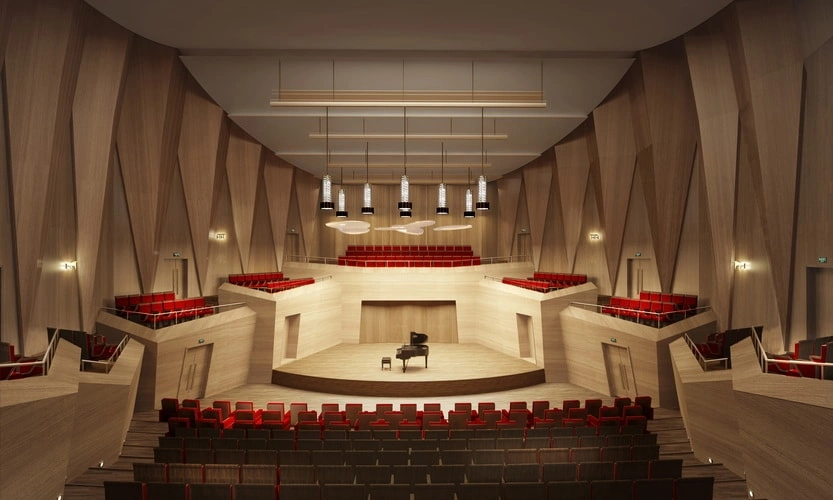
Shoebox Hall Acoustic Principles: Specifically, rectangular halls with parallel side walls create multiple lateral reflections supporting spatial impression while maintaining natural acoustic balance. Moreover, the simple geometry produces predictable, uniform acoustic response throughout seating areas. Nevertheless, careful absorption placement and diffusion prevent flutter echo between parallel walls.
Vineyard Configuration Advantages: Conversely, vineyard-style halls with seating surrounding the stage maximize visual and acoustic intimacy by minimizing performer-audience distance. Additionally, terraced seating blocks create beneficial early reflections. However, sophisticated suspended reflector systems become essential for directing sound appropriately throughout the space.
4.2 Room Proportions, Dimensions & Volume Optimization
Subsequently, concert hall proportions, dimensions, and total volume significantly influence acoustic character and performance.
Table 10: Optimal Concert Hall Dimensional Relationships
| Dimensional Parameter | Optimal Range | Acoustic Benefit | Design Considerations |
|---|---|---|---|
| Length:Width Ratio | 1.5:1 to 2.5:1 | Reduces axial standing waves | Shoebox halls typically 2:1 to 2.5:1 |
| Height:Width Ratio | 0.7:1 to 1.2:1 | Vertical sound distribution, volume | Higher ceilings increase reverberation |
| Stage Width:Hall Width | 0.6:1 to 0.8:1 | Orchestra accommodation, projection | Wider stages reduce projection efficiency |
| Volume per Seat | 8-12 m³/person | Reverberation time control | Larger volumes = longer RT |
| Maximum Hall Width | ≤28 meters | Lateral reflection effectiveness | Wider halls lose intimacy |
| Maximum Seating Distance | ≤35-40 meters | Visual and acoustic intimacy | Balconies extend effective distance |
4.3 Ceiling Configuration & Overhead Reflector Systems
Moreover, ceiling design represents one of the most powerful acoustic control elements, simultaneously influencing reverberation time, early reflections, and sound distribution.
Table 11: Ceiling Design Strategies for Concert Halls
| Ceiling Type | Acoustic Function | Typical Configuration | Height Range | Applications |
|---|---|---|---|---|
| Flat Reflective | Uniform downward reflections | Plaster or wood, parallel to floor | 12-16 meters | Traditional shoebox halls |
| Barrel Vault | Diffusion and projection | Curved longitudinal section | 15-20 meters | Romantic-era halls |
| Faceted/Sculptured | Targeted reflections, diffusion | Angled panels, complex geometry | 12-18 meters | Modern halls |
| Suspended Reflectors | Adjustable early reflections | Individual panels, motorized | 8-15 meters | Vineyard configurations |
| Coffered | Diffusion, visual interest | Recessed panels creating relief | 12-16 meters | Historic precedents |
Reflector Panel Optimization: Furthermore, suspended reflector panels above the stage and seating area enable precise control of early reflection patterns. Specifically, reflector angle, position, and area determine which seating zones receive enhanced acoustic support. Nevertheless, reflector systems require sophisticated acoustic modeling during design development ensuring optimal configuration.
4.4 Side Wall Treatment: Balancing Reflection, Absorption & Diffusion
In addition, side wall configuration critically influences lateral energy fraction and spatial impression while managing overall reverberation time.
Table 12: Side Wall Acoustic Treatment Strategies
| Wall Zone | Distance from Stage | Primary Treatment | NRC Range | Typical Materials | Acoustic Purpose |
|---|---|---|---|---|---|
| Front Zone | 0-10 meters | Reflective with diffusion | 0.05-0.15 | Wood panels, plaster, diffusers | Strong lateral reflections |
| Middle Zone | 10-25 meters | Mixed reflective/absorptive | 0.15-0.30 | Combination treatments | Balance reverberation |
| Rear Zone | >25 meters | Primarily absorptive | 0.50-0.80 | Fabric panels, thick insulation | Control excess reverberation |
| Upper Walls | Above seating | Diffusive or mixed | 0.10-0.25 | Sculptural elements, acoustic panels | Vertical sound distribution |
| Balcony Fronts | Varies | Reflective or diffusive | 0.05-0.20 | Wood, shaped surfaces | Reflections to orchestra below |
Part Five: Stage Acoustics & Musician Support Systems
5.1 Stage Enclosure Design for Orchestral & Chamber Performance
Initially, stage enclosure acoustics profoundly affect musician performance quality by providing essential early reflections enabling self-hearing and ensemble communication.
Table 13: Stage Acoustic Design Requirements
| Stage Element | Acoustic Function | Design Parameters | Target Performance | Critical Considerations |
|---|---|---|---|---|
| Rear Wall | Bass support, reflections to musicians | Massive, reflective surface | ST1: -12 to -15 dB | Provides foundation for orchestra |
| Side Walls/Towers | Lateral reflections for sections | Angled toward orchestra | Enable cross-stage hearing | Adjustable for different ensemble sizes |
| Ceiling/Canopy | Overhead reflections | Height-adjustable 8-12m | Distributes sound evenly | Too low = boxy, too high = weak |
| Floor | Tonal response, vibration coupling | Sprung wood construction | Resonant but controlled | Critical for string instruments |
| Opening to Hall | Acoustic coupling | No barriers | Efficient projection | Full integration with hall acoustics |
5.2 Orchestra Shell Systems: Adjustable Acoustic Enclosures
Subsequently, modular orchestra shell systems enable halls to transform between symphony configuration and other uses such as amplified performances or flat-floor events.
Fixed vs. Portable Shell Systems: Notably, fixed shells provide superior acoustic performance through massive construction and precise installation, whereas portable shells offer operational flexibility at the cost of some acoustic compromise. Moreover, motorized adjustable shells represent premium solutions combining optimal acoustics with configuration versatility.
Shell Construction Materials: Additionally, shell panels typically employ 25-50mm thick wood or composite construction providing appropriate mass and stiffness for sound reflection. Furthermore, panels must resist warping and maintain stable geometric relationships under varying environmental conditions.
Part Six: Sound Isolation & Background Noise Control for Concert Venues
6.1 External Noise Isolation: Urban Concert Hall Challenges
First, urban concert halls face severe external noise challenges from traffic, aircraft, rail transit, and pedestrian activity requiring exceptional sound isolation performance.
Table 14: External Noise Isolation Strategies & Construction Methods
| Isolation Strategy | Typical STC | Cost Multiplier | Applications | Construction Details |
|---|---|---|---|---|
| Standard Mass Wall | STC 50-55 | 1.0x | Suburban locations, low noise | Single-wythe masonry, minimal treatment |
| Cavity Wall | STC 60-65 | 1.5-2.0x | Urban locations, moderate noise | Double-wythe with air gap, insulation |
| Decoupled Wall | STC 65-70 | 2.0-2.5x | Dense urban, high noise | Independent stud walls, isolation |
| Room-in-Room | STC 70-75+ | 3.0-4.0x | Extreme noise environments | Completely isolated structure |
6.2 HVAC System Design: Silent Environmental Control for Musical Spaces
Moreover, HVAC systems must provide thermal comfort while operating virtually silently to avoid masking pianissimo musical passages.
Table 15: HVAC Noise Control Hierarchy for Concert Halls
| Control Strategy | Target Contribution | Implementation Method | Effectiveness | Design Complexity |
|---|---|---|---|---|
| Source Selection | <NC 10 per source | Ultra-quiet equipment, oversized | Highest | Moderate |
| Low-Velocity Distribution | <NC 5 from air movement | Large ducts, <3 m/s velocity | Very High | High |
| Acoustic Attenuation | 25-35 dB insertion loss | Multiple silencers, lined ducts | High | Moderate |
| Vibration Isolation | Eliminate structure-borne | Spring isolators, flexible connections | High | Moderate |
| Diffuser Selection | <NC 5 from terminals | Premium low-velocity diffusers | Moderate | Low |
| System Zoning | Shutdown during performance | Thermal mass, pre-conditioning | Very High | High |
Critical HVAC Design Parameters:
- Maximum supply velocity: 2-3 m/s in main ducts, <2 m/s near hall
- Silencer specifications: 30-40 dB insertion loss at critical frequencies
- Equipment location: Remote from performance space, vibration isolated
- Control strategy: Variable volume, performance mode shutdown capability
Part Seven: Seating, Audience Area & Balcony Acoustic Design
7.1 Seating Configuration & Audience Absorption Management
Additionally, seating design significantly impacts both audience comfort and acoustic performance through absorption characteristics and geometric configuration.
Table 16: Seating Types & Acoustic Characteristics
| Seating Type | Occupied Absorption | Empty Absorption | Absorption Difference | Design Implications |
|---|---|---|---|---|
| Traditional Upholstered | 0.85-0.95 Sabins/seat | 0.55-0.65 Sabins/seat | 30-40% increase occupied | Large RT variation empty/full |
| Highly Absorptive | 0.90-0.98 Sabins/seat | 0.75-0.85 Sabins/seat | 15-20% increase occupied | Minimizes RT variation |
| Lightly Upholstered | 0.75-0.85 Sabins/seat | 0.40-0.50 Sabins/seat | 40-50% increase occupied | Maximum RT variation |
| Perforated Seat Backs | 0.85-0.95 Sabins/seat | 0.70-0.80 Sabins/seat | 10-15% increase occupied | Excellent consistency |
7.2 Balcony Design: Maximizing Capacity While Preserving Acoustics
Furthermore, balcony design enables increased seating capacity while potentially enhancing acoustic performance through beneficial reflections and reduced hall volume.
Table 17: Balcony Acoustic Design Guidelines
| Design Parameter | Recommended Value | Acoustic Rationale | Practical Considerations |
|---|---|---|---|
| Maximum Overhang Depth | <2× ceiling height beneath | Prevents acoustic shadowing | Limits projection distance |
| Front Face Treatment | Reflective or diffusive | Early reflections to orchestra | Wood, shaped surfaces |
| Soffit Treatment | Moderately absorptive (NRC 0.40-0.60) | Reduces balcony rear reflections | Acoustic panels, ceiling treatment |
| Rear Wall Treatment | Highly absorptive (NRC 0.70-0.90) | Eliminates long-delay echoes | Thick absorption, wall panels |
| Balcony Rake | Steeper than main floor | Improves sightlines, reduces shadowing | Structural, accessibility impacts |
Part Eight: Variable Acoustic Systems for Multi-Purpose Concert Venues
8.1 Rationale & Technologies for Adjustable Room Acoustics
Notably, concert halls serving diverse musical repertoire face conflicting acoustic requirements between optimal conditions for different performance types. Consequently, variable acoustic systems enable adaptation rather than accepting compromise.
Table 18: Variable Acoustic Technologies Comparison
| Technology | RT Adjustment Range | Response Time | Maintenance | Capital Cost | Operating Cost | Optimal Applications |
|---|---|---|---|---|---|---|
| Retractable Banners/Curtains | ±0.3-0.5 seconds | 10-20 minutes | Moderate | Moderate | Low | Mid-size halls, moderate budgets |
| Rotating Panels | ±0.2-0.4 seconds | 15-30 minutes | Low | High | Very Low | Premium halls, architectural integration |
| Coupled Chamber Systems | ±0.4-0.8 seconds | 2-5 minutes | Very Low | Very High | Very Low | Large halls, significant budget |
| Active Acoustic Systems | Wide flexibility | Instantaneous | Moderate | High | Moderate | Controversial, electronic enhancement |
Part Nine: Materials Selection & Acoustic Surface Treatment
9.1 Reflective Materials for Sound Projection & Early Reflections
Table 19: Reflective Acoustic Materials for Concert Halls
| Material | Absorption Coefficient (125-4000 Hz) | Applications | Acoustic Characteristics | Aesthetic Qualities | Cost Factor |
|---|---|---|---|---|---|
| Plaster on Masonry | 0.01-0.05 | Walls, ceilings | Excellent reflection, slight diffusion | Traditional, elegant | Low-Moderate |
| Hardwood Paneling | 0.05-0.15 | Walls, stage, ceilings | Warm reflection, natural resonance | Premium, prestigious | High |
| Concrete/Stone | 0.01-0.03 | Structural surfaces | Very strong reflection | Modern, monumental | Low |
| Glass | 0.03-0.05 | Windows, architectural | Clear reflection | Contemporary, transparent | Moderate |
| Metal Panels | 0.02-0.05 | Ceilings, features | Bright reflection | Modern, industrial | Moderate-High |
9.2 Absorptive Materials for Reverberation Control & Echo Prevention
Table 20: Absorptive Acoustic Materials & Applications
| Material Type | NRC Range | Optimal Thickness | Fire Rating | Applications | Frequency Performance |
|---|---|---|---|---|---|
| Fiberglass/Mineral Wool | 0.80-1.00 | 75-200mm | Class A | Rear walls, ceiling zones | Excellent full-spectrum |
| Fabric-Wrapped Panels | 0.70-0.90 | 50-100mm | Class A | Walls, ceilings, decorative | Customizable appearance |
| Perforated Wood Absorbers | 0.40-0.70 | 25-75mm + cavity | Varies | Side walls, aesthetic areas | Tunable frequency response |
| Micro-Perforated Panels | 0.50-0.80 | Variable cavity | Class A | Ceilings, modern halls | Narrow-band tunable |
| Acoustic Plaster | 0.30-0.60 | 15-25mm | Class A | Seamless ceilings | Limited low-frequency |
Part Ten: Acoustic Measurement, Testing & Performance Verification
10.1 Comprehensive Acoustic Testing Protocol for Concert Venues
Table 21: Required Acoustic Measurements & Acceptance Criteria
| Parameter Category | Specific Measurements | Test Standard | Measurement Positions | Acceptance Criteria | Test Conditions |
|---|---|---|---|---|---|
| Reverberation | RT60, T20, T30, EDT | ISO 3382-1 | 12-24 positions | Within ±10% of target | Empty and occupied |
| Clarity & Definition | C80, C50, D50 | ISO 3382-1 | 12-24 positions | Meet typology targets | Multiple source positions |
| Sound Strength | G (mid, bass) | ISO 3382-1 | 12-24 positions | +4 to +8 dB range | Calibrated source |
| Spatial Impression | LF, IACC | ISO 3382-1 | 6-12 positions | LF ≥0.20, IACC <0.65 | Binaural measurements |
| Stage Acoustics | ST1, ST2 | ISO 3382-1 | Stage grid positions | -12 to -15 dB (ST1) | On-stage sources |
| Background Noise | NC, NR, dBA, spectra | ISO 1996-2 | 6-12 positions | ≤NC 20 (world-class) | All systems operational |
10.2 Acoustic Modeling & Simulation Methodologies
Furthermore, contemporary concert hall design relies heavily on sophisticated computer acoustic modeling enabling performance prediction and design optimization before construction.
Primary Simulation Software Platforms:
- ODEON: Industry-leading room acoustics software with high accuracy
- CATT-Acoustic: Advanced geometric acoustics simulation
- EASE: Integrated architectural and sound system modeling
- Ramsete: Research-grade acoustic prediction
Part Eleven: Case Studies of Legendary Concert Halls
11.1 Iconic Concert Hall Analysis & Lessons Learned
Table 22: World-Class Concert Hall Acoustic Characteristics
| Concert Hall | Location | Capacity | RT60 (occupied) | Typology | Key Success Factors | Notable Characteristics |
|---|---|---|---|---|---|---|
| Vienna Musikverein | Austria | 1,744 | 2.0 seconds | Shoebox | Perfect proportions, plaster surfaces | Legendary warmth, clarity |
| Boston Symphony Hall | USA | 2,625 | 1.8 seconds | Shoebox | Sabine’s scientific design | First acoustically-designed hall |
| Berlin Philharmonie | Germany | 2,440 | 2.0 seconds | Vineyard | Terraced seating, intimacy | Revolutionary asymmetric design |
| Amsterdam Concertgebouw | Netherlands | 2,037 | 2.2 seconds | Shoebox | Tall proportions, wood finishes | Exceptional bass warmth |
| Suntory Hall | Japan | 2,006 | 2.0 seconds | Vineyard | Precision engineering | Perfect blend of traditions |
Conclusion: Achieving Acoustic Excellence Through Integrated Design
In conclusion, world-class concert hall acoustic design demands extraordinary integration of scientific understanding, artistic sensitivity, and technical mastery. Specifically, success requires:
Scientific Rigor: Applying validated acoustic principles and measurement methodologies Artistic Vision: Understanding musical performance and aesthetic aspirations Technical Excellence: Precise material specification, construction quality, and testing verification Collaborative Process: Seamless coordination among architects, acousticians, musicians, and builders
Ultimately, exceptional concert hall acoustics elevate musical performance from technical execution to transcendent artistic experience, creating lasting cultural institutions that enrich communities for generations.