
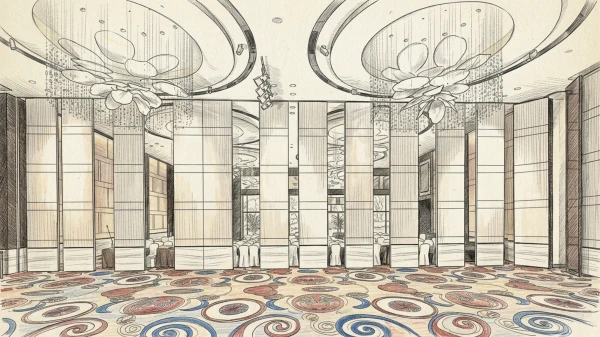
Introduction: Why Banquet Hall Acoustics Define the Event Experience
First and foremost, the acoustic environment of a banquet hall is one of the most consequential — and most frequently neglected — dimensions of event venue design. A beautifully appointed banquet hall with poor acoustics becomes a source of frustration, fatigue, and complaint regardless of the quality of its catering, décor, or service. Conversely, a hall that has been acoustically engineered to the correct standards allows every guest to converse comfortably, every speaker to be heard clearly, and every musical performance to be enjoyed fully — fundamentally transforming the experience of every event held within it.
Consequently, banquet hall acoustic design presents a unique set of engineering challenges. Unlike fixed-program venues such as concert halls or cinemas, banquet facilities must simultaneously accommodate an extraordinarily diverse range of activities: formal dinners with background music, wedding receptions with live bands, corporate award ceremonies with amplified speeches, cocktail receptions with ambient sound, and conference-style banquet sessions requiring high speech intelligibility throughout a large reverberant space. Furthermore, the occupancy levels, furniture arrangements, and sound system configurations change dramatically from event to event, requiring acoustic solutions that perform consistently across highly variable conditions.
This comprehensive guide provides the technical framework, international standards, design strategies, and material specifications required to design, specify, and evaluate banquet hall acoustic environments to the highest professional standards. Understanding architectural acoustics for multi-use event venues requires mastery of both physical acoustic science and the practical realities of venue operation.
Specifically, this resource addresses reverberation time control, speech intelligibility optimization, sound isolation from adjacent spaces, background noise management, sound system acoustic integration, and the material and construction strategies that deliver consistently excellent acoustic performance in banquet and event venues of all sizes.
Part One: Banquet Hall Acoustic Fundamentals & Multi-Use Design Challenges
1.1 The Unique Acoustic Complexity of Banquet Venues
Initially, it is essential to recognize that banquet halls represent one of the most acoustically complex venue typologies in the built environment. The challenge arises not from any single acoustic parameter being extreme, but from the requirement that multiple acoustic parameters be simultaneously optimized for genuinely contradictory use cases. Speech-oriented events require short reverberation times and high speech intelligibility; music performance events benefit from longer reverberation and greater warmth; large social gatherings generate enormous crowd noise that must be controlled to prevent the acoustic environment from becoming a source of social stress.
Moreover, banquet halls typically feature the physical characteristics most hostile to good acoustics: large volumes with high ceilings, extensive hard reflective surfaces (stone, tile, glass, plaster), minimal permanent soft furnishings, and irregular geometries created by balconies, alcoves, and service areas. Additionally, the variable occupancy of banquet events — ranging from intimate dinners of 50 to gala events of 500 or more — means that the acoustic absorption contributed by audience members changes dramatically, directly affecting reverberation time and overall acoustic character.
Consequently, professional banquet hall acoustic design must employ variable acoustic systems, carefully specified surface treatments, appropriate volume management strategies, and integrated sound system design to deliver acceptable performance across the full range of intended uses.
Table 1: Core Acoustic Challenges in Banquet Hall Design by Event Type
| Event Type | Occupancy Level | Primary Acoustic Challenge | Key Metric | Design Priority |
|---|---|---|---|---|
| Formal dinner / gala | 60–100% capacity | Crowd noise, speech privacy at tables | RT60, NC | High |
| Wedding reception | 80–100% capacity | Band/DJ noise control, speech clarity at ceremony | STC, RT60 | Critical |
| Corporate awards ceremony | 50–80% capacity | Speech intelligibility throughout hall | STI, RT60 | Critical |
| Cocktail reception (standing) | 60–90% capacity | Cocktail party effect, noise fatigue | NC, RT60 | High |
| Conference banquet session | 40–70% capacity | Amplified speech clarity, Q&A intelligibility | STI, NC | Critical |
| Live music performance | 70–100% capacity | Music balance, excessive reverberation | RT60, SPL | High |
| Product launch / presentation | 30–60% capacity | AV system integration, projector clarity | STI, NC | High |
| Multi-room banquet suite | Variable | Sound bleed between rooms, privacy | STC, NIC | Critical |
1.2 Eight Critical Design Principles for Banquet Hall Acoustics
Subsequently, successful banquet hall acoustic design is governed by eight interrelated principles that must be addressed comprehensively rather than in isolation. First, volume-to-occupancy ratio management ensures that the acoustic volume of the space matches the intended maximum occupancy, avoiding both the excessive intimacy of underscaled rooms and the acoustic harshness of oversized halls. Second, surface treatment balance between reflective and absorptive elements controls reverberation time without creating deadness or echo. Third, geometry optimization uses ceiling angles, wall configurations, and balcony profiles to distribute sound energy evenly throughout the occupied area.
Fourth, variable acoustic capability through movable elements, adjustable panels, or acoustic drapery allows the venue to adapt between different event configurations. Fifth, mechanical noise control ensures that HVAC and other building systems do not intrude on the acoustic environment. Sixth, sound isolation between adjacent spaces — particularly in multi-room banquet complexes — prevents event activity in one room from disturbing adjacent functions. Seventh, sound system acoustic integration designs the electroacoustic system in harmony with the room acoustics rather than in opposition to them. Eighth, flanking path control ensures that structural connections, ductwork, and penetrations do not undermine the acoustic boundaries between spaces.
Part Two: International Standards & Acoustic Performance Guidelines for Banquet Halls
2.1 Applicable International Acoustic Standards
Furthermore, banquet hall acoustic design draws upon a broader base of applicable standards than most other venue typologies, reflecting the diversity of activities the space must support. The core measurement standards from ISO and ASTM International provide the technical foundation, while specific performance guidelines from hospitality industry bodies, accessibility standards, and acoustic consulting practice publications establish the performance benchmarks.
Table 2: International Standards Applicable to Banquet Hall Acoustic Design
| Standard | Issuing Body | Scope | Key Requirement for Banquet Halls | Revision Year |
|---|---|---|---|---|
| ISO 3382-1 | ISO | RT measurement in performance spaces | RT60 measurement methodology for large rooms | 2009 |
| ISO 3382-2 | ISO | RT measurement in ordinary rooms | RT60 targets for speech-oriented spaces | 2008 |
| ISO 3382-3 | ISO | Open plan offices / large spaces | STI measurement in noisy environments | 2012 |
| ANSI S12.60 | ANSI | Acoustics in learning environments | Speech intelligibility standards (STI ≥ 0.60) | 2010 |
| IEC 60268-16 | IEC | Sound system equipment — STI | STIPA measurement methodology | 2020 |
| ISO 16283-1 | ISO | Field measurement of airborne sound | STC/DnT,w between adjacent event rooms | 2014 |
| ASTM E336 | ASTM | Field sound transmission | NIC between banquet suites | 2023 |
| BS 8233:2014 | BSI | Guidance on sound insulation | Background noise targets for assembly spaces | 2014 |
| CIBSE Guide B | CIBSE | Building services engineering | HVAC noise criteria for assembly spaces | Current |
2.2 Performance Target Summary by Acoustic Parameter
Table 3: Recommended Acoustic Performance Targets for Banquet Halls by Space Category
| Acoustic Parameter | Small Hall (< 500 m²) | Medium Hall (500–1,500 m²) | Large Hall (> 1,500 m²) | Standard Reference |
|---|---|---|---|---|
| RT60 (mid-frequency, occupied) | 0.8–1.2 s | 1.0–1.4 s | 1.2–1.6 s | ISO 3382-1 / ANSI |
| RT60 (mid-frequency, unoccupied) | 1.2–1.8 s | 1.4–2.0 s | 1.6–2.4 s | ISO 3382-1 |
| STI (speech intelligibility) | ≥ 0.60 (Good) | ≥ 0.55 (Good) | ≥ 0.50 (Fair–Good) | IEC 60268-16 |
| Background noise (NC) | NC 30–35 | NC 30–35 | NC 35–40 | ANSI S12.2 |
| Adjacent room STC | STC 50–55 | STC 55–60 | STC 55–65 | ASTM E336 |
| Bass ratio (BR = RT125+250/RT500+1000) | 1.0–1.2 | 1.0–1.3 | 1.0–1.3 | ISO 3382-1 |
| Clarity C80 (music events) | −2 to +2 dB | −2 to +2 dB | −3 to +2 dB | ISO 3382-1 |
| Early Decay Time (EDT) | 0.8–1.4 s | 1.0–1.6 s | 1.2–1.8 s | ISO 3382-1 |
2.3 Speech Intelligibility Standards — The Central Performance Metric
Importantly, speech intelligibility — quantified by the Speech Transmission Index (STI) and its simplified variant STIPA — represents the single most critical acoustic performance metric for banquet halls used for speeches, ceremonies, and conference-style events. The STI scale runs from 0 (unintelligible) to 1.0 (perfect intelligibility), with the following perceptual classifications governing professional acoustic design practice.
Table 4: STI Scale, Perceptual Classification & Banquet Hall Application
| STI Value | Intelligibility Class | Perception | Banquet Hall Application | Acceptability |
|---|---|---|---|---|
| 0.00–0.30 | Bad | Speech unintelligible | Unacceptable for any speech use | Never acceptable |
| 0.30–0.45 | Poor | Only fragments understood | Unacceptable for presentations | Not acceptable |
| 0.45–0.60 | Fair | Significant listening effort | Marginal for speeches, needs improvement | Borderline |
| 0.60–0.75 | Good | Comfortable intelligibility | Acceptable for all banquet speech uses | Standard target |
| 0.75–0.90 | Excellent | Very easy intelligibility | Premium venues, hearing-impaired accessibility | Best practice |
| 0.90–1.00 | Perfect | Effortless understanding | Exceeds all practical requirements | Exceptional |
Part Three: Reverberation Time Design — Targets, Calculation & Control Strategies
3.1 RT60 Targets for Banquet Halls
Notably, reverberation time management is the central acoustic design challenge of banquet hall acoustics. The RT60 target for a banquet hall is more complex to specify than for a single-purpose venue because the optimal value differs significantly depending on the primary event type. Moreover, the change in acoustic absorption between an empty hall and a fully occupied hall — where every seated guest contributes meaningful absorption — can shift the reverberation time by 30–50%, fundamentally altering the acoustic character of the space.
Table 5: RT60 Targets by Room Volume & Event Use Emphasis
| Hall Volume (m³) | Primarily Speech Events | Primarily Social/Dining | Mixed Use (Recommended) | Music Performance |
|---|---|---|---|---|
| < 1,000 m³ | 0.6–0.8 s | 0.9–1.2 s | 0.8–1.0 s | 1.0–1.4 s |
| 1,000–3,000 m³ | 0.7–1.0 s | 1.0–1.4 s | 0.9–1.2 s | 1.2–1.6 s |
| 3,000–6,000 m³ | 0.8–1.1 s | 1.1–1.5 s | 1.0–1.4 s | 1.4–1.8 s |
| 6,000–12,000 m³ | 0.9–1.2 s | 1.2–1.6 s | 1.1–1.5 s | 1.5–2.0 s |
| > 12,000 m³ | 1.0–1.4 s | 1.3–1.8 s | 1.2–1.6 s | 1.6–2.2 s |
3.2 Sabine’s Formula & Acoustic Volume Calculation
Table 6: Sabine Equation Application for Banquet Hall RT60 Design
| Design Variable | Symbol | Typical Banquet Hall Range | Design Impact | Optimization Strategy |
|---|---|---|---|---|
| Room Volume | V (m³) | 1,000–15,000 m³ | Larger volume = longer RT60 | Match volume to intended occupancy × 10–15 m³/person |
| Total Absorption | A (m² Sabins) | 200–4,000 m² Sabins | More absorption = shorter RT60 | Balance fixed + variable absorption elements |
| Target RT60 | T (seconds) | 0.8–1.6 s (occupied) | Lower = better speech, higher = better music | Design for mid-point of use range |
| Occupant Absorption | per person | 0.3–0.5 m² Sabins/person | Significant in large crowds | Calculate occupied vs. unoccupied separately |
| Sabine Formula | T = 0.161 × V/A | — | Fundamental design equation | Verify with Eyring equation for high-absorption rooms |
3.3 Frequency-Specific RT60 Design Requirements
Furthermore, reverberation time is not constant across the frequency spectrum — it must be considered at each octave band from 125 Hz to 4000 Hz to fully characterize the acoustic character of a banquet hall. Specifically, low-frequency reverberation (125–250 Hz) controls the perceived warmth and richness of the acoustic environment, while mid-frequency reverberation (500–1000 Hz) is most directly relevant to speech intelligibility, and high-frequency reverberation (2000–4000 Hz) affects the sense of intimacy and clarity.
Table 7: Frequency-Specific RT60 Targets for Banquet Hall Design
| Octave Band Centre Frequency | Target RT60 (Unoccupied) | Target RT60 (Occupied) | Design Challenge | Primary Control Material |
|---|---|---|---|---|
| 125 Hz | 1.4–2.2 s | 1.0–1.6 s | Most difficult to control | Deep mineral wool bass traps, thick panels |
| 250 Hz | 1.3–2.0 s | 0.9–1.5 s | Requires significant absorption depth | 75–100mm mineral wool panels |
| 500 Hz | 1.2–1.8 s | 0.8–1.3 s | Mid-frequency reference band | Standard acoustic panels, upholstery |
| 1000 Hz | 1.1–1.7 s | 0.7–1.2 s | Critical for speech intelligibility | Carpet, seating upholstery, acoustic ceiling |
| 2000 Hz | 1.0–1.6 s | 0.7–1.1 s | Audience absorption effective | Fabric panels, drapes, occupants |
| 4000 Hz | 0.9–1.4 s | 0.6–1.0 s | Air absorption increases with distance | Standard absorptive treatments |
Part Four: Architectural Design Strategies for Banquet Hall Acoustics
4.1 Volume Optimization & Ceiling Height Design
Initially, the acoustic volume of a banquet hall is its most fundamental acoustic parameter, establishing the baseline reverberation time before any surface treatment is applied. Professional acoustic design practice recommends a volume allocation of 10–15 m³ per person for banquet venues designed primarily for speech and dining, increasing to 12–18 m³ per person for venues designed to accommodate live music performance. Consequently, a hall designed for 500 guests should ideally have an acoustic volume of 5,000–7,500 m³ for mixed-use programming.
Moreover, ceiling height directly determines the relative balance between direct sound (traveling from source to listener without reflection) and reflected sound (arriving later via reflections from ceiling and walls). Specifically, ceiling heights below 5 meters tend to create a sense of acoustic intimacy but can cause problematic reflections if the ceiling surface is reflective. Ceiling heights above 9 meters provide generous acoustic volume but may create delayed reflections and echo problems if not addressed with appropriate absorptive or diffusive treatment.
Table 8: Ceiling Height Design Guide for Banquet Hall Acoustic Performance
| Ceiling Height | Volume Impact | Acoustic Character | Primary Risk | Recommended Treatment |
|---|---|---|---|---|
| < 4.5 m | Low volume | Intimate but potentially oppressive | Flutter echo between parallel surfaces | Absorptive ceiling tiles + diffusive wall panels |
| 4.5–6.0 m | Medium-low | Comfortable for dining, limited for music | Short RT60 when occupied, adequate for speech | Acoustic ceiling system + wall absorption |
| 6.0–8.0 m | Medium | Good balance for mixed use | Requires careful surface treatment management | Suspended acoustic baffles + perimeter treatment |
| 8.0–10.0 m | Medium-high | Good music volume, requires absorption management | Excessive RT60 if insufficient treatment | Acoustic cloud arrays + wall panels + carpet |
| 10.0–14.0 m | High | Impressive grandeur, acoustically challenging | Echo, long RT60, uneven distribution | Extensive hanging baffles + distributed absorption |
| > 14.0 m | Very high | Monumental scale, very difficult acoustics | Severe echo, flutter, poor STI | Major acoustic intervention required — specialist design |
4.2 Surface Geometry & Sound Reflection Management
Additionally, the geometry of reflective surfaces within a banquet hall has a profound influence on acoustic quality, often independent of the total absorption installed. Parallel wall pairs create flutter echo — a rapid series of discrete reflections that give speech a characteristic metallic ringing quality and are particularly objectionable in large spaces. Similarly, concave ceiling domes and curved walls can focus sound energy at specific points in the hall, creating areas of excessive loudness adjacent to areas of acoustic deficiency.
Therefore, professional banquet hall acoustic design incorporates geometric strategies to manage reflections constructively: angling ceiling panels by 5–10 degrees relative to horizontal to direct reflections toward the audience rather than back to the source; splaying walls by 3–8 degrees from parallel to eliminate flutter echo; incorporating coffered, faceted, or otherwise irregular ceiling geometries that distribute reflected energy broadly rather than focusing it.
Table 9: Surface Geometry Options & Acoustic Effects in Banquet Hall Design
| Geometric Element | Configuration | Acoustic Effect | Design Recommendation | Application Priority |
|---|---|---|---|---|
| Main ceiling (flat, reflective) | Horizontal, plaster | Strong, even reflection — good for near-field; echo risk in large halls | Treat with acoustic tiles or suspended clouds | High |
| Main ceiling (angled, segmented) | 5–15° pitch sections | Directed reflections toward seating — reduces echo risk | Preferred over flat reflective ceiling | Very High |
| Coffered ceiling | Regular grid of recesses | Diffuses reflections across frequencies — reduces flutter | Excellent acoustic geometry if properly proportioned | High |
| Parallel side walls | Vertical, flat | Flutter echo source — acoustically problematic | Splay by minimum 3° or add diffusive treatment | Critical |
| Splayed side walls | 3–8° from parallel | Eliminates flutter echo, improves diffusion | Standard best practice | Critical |
| Rear wall (facing stage/podium) | Flat, vertical | Strong discrete echo — problematic for speech | Apply absorption or convex diffusion | Critical |
| Balcony face | Angled downward | Can project useful reflections toward main floor | Angle to direct sound into rear of hall | Medium |
4.3 Stage & Presentation Area Acoustic Design
Specifically, the stage, podium, or presentation area of a banquet hall requires particular acoustic attention because it is both the primary sound source for speech and music events and the location where acoustic conditions most directly affect the ability of performers and speakers to monitor their own output. Consequently, the acoustic environment immediately surrounding the presentation area must provide appropriate early reflections to support speech projection, adequate monitoring levels for performers, and controlled isolation from the excessive reverberation of the main hall volume.
Furthermore, sound system speaker placement relative to the stage acoustic environment is critical: speakers positioned directly above or beside the stage can cause feedback problems if not carefully aimed and equalized, while distributed speaker arrays elsewhere in the hall may provide excellent coverage of the seating area while leaving the stage monitoring inadequately supported.
Part Five: Sound Isolation Standards for Multi-Room Banquet Complexes
5.1 Inter-Room Sound Isolation Requirements
Moreover, most commercial banquet facilities include multiple event spaces operating simultaneously, making inter-room sound isolation a critical design consideration. The acoustic bleed-through of a rock band from Hall A into a wedding ceremony in Hall B represents a catastrophic venue management failure that undermines both events and the reputation of the facility. Therefore, sound isolation between adjacent banquet spaces must be engineered to a standard that accommodates simultaneous peak-use scenarios.
The soundproofing requirements for multi-room banquet complexes are among the most demanding in hospitality construction, because the potential sound pressure levels generated by amplified music events (typically 95–105 dB(A) at the source) are far greater than those of any residential or office application.
Table 10: Sound Isolation Requirements Between Banquet Facility Spaces
| Space Pair | Typical Source SPL | Required STC | Best Practice STC | Construction Type | Priority |
|---|---|---|---|---|---|
| Banquet hall to banquet hall | 90–105 dB(A) | STC 60–65 | STC 65–70 | Double-stud + resilient + mass | Critical |
| Banquet hall to hotel guestroom | 90–105 dB(A) | STC 65–70 | STC 70+ | Double-wall + floating floor | Critical |
| Banquet hall to kitchen / BOH | 80–95 dB(A) | STC 50–55 | STC 55–60 | Concrete or CMU + resilient | High |
| Banquet hall to corridor | 85–100 dB(A) | STC 55–60 | STC 60–65 | Double-layer GWB + decoupled frame | High |
| Banquet hall to office / meeting room | 85–100 dB(A) | STC 55–60 | STC 60–65 | Double-stud or concrete wall | High |
| Sub-divided hall (operable partition) | 85–100 dB(A) | STC 45–50 (partition only) | STC 50–55 | Premium operable partition system | Medium-High |
| Banquet hall to parking / plant room | 90–105 dB(A) | STC 60–65 | STC 65–70 | Concrete slab + floating floor | High |
5.2 Operable Partition System Performance Standards
Additionally, operable partition systems — movable acoustic walls that allow banquet halls to be subdivided into smaller rooms — represent a major acoustic engineering challenge. The inherent performance gap between a permanent wall (STC 60–70) and a high-quality operable partition (STC 48–55) means that even the best movable wall systems cannot achieve the isolation levels of fixed construction, and venue programming must account for this limitation.
Table 11: Operable Partition System Performance Comparison
| System Type | Typical STC Rating | Operation Mode | Seal System | Relative Cost | Best Application |
|---|---|---|---|---|---|
| Standard folding partition | STC 35–42 | Manual fold & stack | Compression seals top & bottom | $ | Low-noise division only |
| Acoustic folding panel (manual) | STC 42–48 | Manual, panel by panel | Multi-point edge seals | $$ | Moderate isolation needs |
| Acoustic sliding partition (motorized) | STC 48–53 | Motorized track system | Automatic perimeter seal | $$$ | Premium banquet suites |
| Pass door within partition | STC 25–35 (door only) | Manual door | Perimeter seal + sweep | — | Always specify acoustic door |
| Stacked partition (full ceiling height) | STC 50–55 | Manual stack to pocket | Floor-to-structure seal | $$$$ | Highest performance operable |
5.3 Floor-Ceiling Acoustic Isolation for Multi-Story Banquet Facilities
Furthermore, in multi-story hospitality buildings where banquet halls are positioned above or below other occupied spaces, floor-ceiling acoustic isolation presents perhaps the greatest engineering challenge in the project. The combination of high airborne SPL from music and speech events and potentially significant structure-borne vibration from dancing, moving furniture, and mechanical stage effects demands floor-ceiling assemblies engineered to STC 60–70 and IIC 55–65.
Table 12: Floor-Ceiling Acoustic Assembly Standards for Banquet Hall Applications
| Assembly Configuration | STC Rating | IIC Rating | Construction Notes | Cost Level |
|---|---|---|---|---|
| Standard concrete slab (200mm) with carpet above | 48–52 | 50–55 | Baseline — insufficient for amplified events | $ |
| Concrete slab + acoustic underlayment + floating screed | 55–60 | 58–65 | Good for dining; marginal for amplified music | $$ |
| Concrete slab + resilient ceiling system below | 58–64 | 55–60 | Practical for hotel banquet above guestroom | $$$ |
| Floating floor (kinetics) + concrete slab + resilient ceiling | 65–72 | 65–72 | Premium solution for critical adjacencies | $$$$ |
| Structural concrete + full room-in-room floor system | 70–80 | 70+ | Required for nightclub-adjacent or bass-intensive use | $$$$$ |
Part Six: HVAC Acoustic Design & Background Noise Control
6.1 Mechanical Noise Standards for Banquet Halls
Specifically, the background noise environment of a banquet hall — dominated by HVAC systems — has a profound effect on both acoustic comfort and speech intelligibility. Excessive HVAC noise raises the ambient noise floor, reducing the signal-to-noise ratio for speech and making conversation more effortful for all occupants. Moreover, in large banquet halls with extensive air conditioning requirements, HVAC noise is frequently the primary cause of acoustic complaints and can be as acoustically disruptive as inadequate reverberation control.
Table 13: HVAC Noise Criteria for Banquet Hall Spaces
| Space Type | Recommended NC Level | Maximum NC Level | Equivalent dB(A) | Primary HVAC Strategy |
|---|---|---|---|---|
| Banquet hall (speech/ceremony emphasis) | NC 25–30 | NC 35 | ≤ 35–40 dB(A) | Low-velocity distribution + lined ductwork |
| Banquet hall (dining/social emphasis) | NC 30–35 | NC 40 | ≤ 40–45 dB(A) | Standard distribution + attenuators |
| Pre-function / foyer area | NC 35–40 | NC 45 | ≤ 45–50 dB(A) | Standard distribution |
| Kitchen / back of house | NC 45–55 | NC 60 | ≤ 55–65 dB(A) | No strict requirement |
| AV / production control room | NC 20–25 | NC 30 | ≤ 30–35 dB(A) | Isolated supply + return |
| Green room / artist holding | NC 30–35 | NC 40 | ≤ 40–45 dB(A) | Standard distribution |
6.2 HVAC System Design Strategies for Low Background Noise
Additionally, achieving NC 30–35 or better in large banquet halls requires systematic attention to every element of the HVAC system design, from air handling unit selection through duct sizing, attenuation, and diffuser specification. The following strategies, when applied comprehensively, consistently achieve the NC 30–35 performance targets required for premium banquet facilities.
Table 14: HVAC Acoustic Design Strategies for Banquet Hall NC Compliance
| Strategy | Noise Reduction Potential | Implementation Details | Cost Impact |
|---|---|---|---|
| Low air velocity supply (< 3 m/s in main ducts) | −5 to −10 dB | Upsize ducts; use displacement ventilation where possible | $$ |
| Acoustic duct liner (25mm mineral wool, duct board) | −3 to −8 dB per section | Line all supply/return ducts within 3m of AHU | $ |
| Duct silencers / attenuators (critical paths) | −10 to −25 dB | Install on main supply & return near AHU and at branch points | $$ |
| Flexible connections at AHU & fan coils | −3 to −8 dB | Use neoprene bellows at all mechanical connections | $ |
| Vibration isolation mounting for AHU & fans | −5 to −15 dB | Spring or elastomeric mounts; curb isolators on rooftop units | $$ |
| Return air path acoustic treatment | −5 to −12 dB | Line return plenums; use acoustic return grilles | $ |
| Displacement ventilation (floor-level supply) | −8 to −15 dB (vs overhead) | Low velocity, low turbulence; ideal for high-ceiling halls | $$$ |
| Variable Air Volume (VAV) control | −3 to −8 dB at part load | Reduce noise at partial occupancy; energy benefit | $$ |
Part Seven: Acoustic Surface Treatment Materials & Specifications
7.1 Sound Absorbing Materials for Banquet Hall Interiors
Furthermore, the selection and specification of sound absorbing materials is the primary tool through which acoustic designers control reverberation time and tonal balance in banquet hall environments. The challenge in hospitality contexts is that acoustic materials must deliver excellent performance while simultaneously meeting the aesthetic, maintenance, durability, and fire safety requirements of a high-use commercial venue.
Sound absorption materials for banquet halls must be specified to perform consistently across the occupied and unoccupied conditions of the hall, to resist soiling and damage in a high-traffic environment, to comply with Class A or equivalent fire rating requirements, and to integrate naturally with the interior design language of the venue.
Table 15: Sound Absorbing Materials for Banquet Hall Acoustic Treatment
| Material Type | NRC Range | Frequency Strength | Fire Rating | Maintenance | Best Application |
|---|---|---|---|---|---|
| Acoustic ceiling tiles (mineral fibre) | 0.55–0.90 | Mid–high frequency | Class A | Low — wipe clean | Primary ceiling treatment, suspended systems |
| Fabric-wrapped acoustic wall panels | 0.70–1.05 | Mid–high frequency | Class A (with correct fabric) | Low — fabric can be cleaned | Wall perimeter treatment, feature panels |
| Perforated timber acoustic panels | 0.50–0.85 | Mid–high frequency | Class B–A (with mineral wool backing) | Low | Decorative wall/ceiling panelling |
| Acoustic plaster systems | 0.40–0.75 | Mid–high frequency | Inherently non-combustible | Very low | Premium ceiling and wall finish |
| Heavy velvet acoustic drapes | 0.45–0.65 | Mid–high frequency | Class A (with FR treatment) | Medium — dry cleaning | Variable acoustic elements, perimeter treatment |
| Upholstered banquet seating | 0.30–0.55 per seat | Mid–high frequency | Class A / CRIB 5 | Medium | Primary occupant absorption contribution |
| Carpet (commercial grade, 8mm pile) | 0.25–0.45 | Mid–high frequency | Class A | Medium — professional cleaning | Floor treatment where appropriate |
| Mineral wool baffles (suspended) | 0.80–1.05 | Broad spectrum | Class A (stone wool) | Low | High-ceiling halls, supplementary absorption |
7.2 Acoustic Diffusion Elements for Banquet Hall Design
Moreover, acoustic diffusion plays an equally important but often underutilized role in banquet hall acoustic design. Diffusive surfaces scatter reflected sound energy broadly across many directions rather than producing a single strong specular reflection, thereby reducing the risk of echo and flutter while preserving a sense of acoustic liveliness and spaciousness. Notably, well-designed diffusion maintains the energy of reflected sound — supporting warmth and musical quality — while breaking up the discrete reflections that cause intelligibility problems.
Table 16: Acoustic Diffusion Systems for Banquet Hall Applications
| Diffuser Type | Effective Frequency Range | Diffusion Quality | Aesthetic Character | Installation Location | Cost Level |
|---|---|---|---|---|---|
| QRD (Quadratic Residue Diffuser) | 500 Hz – 4 kHz | Excellent — mathematically optimized | Geometric/sculptural | Rear walls, side walls | $$$ |
| Skyline diffuser (3D QRD) | 250 Hz – 4 kHz | Excellent — broadband | Striking architectural feature | Stage surrounds, ceiling feature | $$$$ |
| Timber geometric relief paneling | 500 Hz – 2 kHz | Good — empirical | Natural, decorative | Side walls, balcony faces | $$ |
| Curved convex wall surfaces | 250 Hz – 1 kHz | Good — scattering | Elegant, classical | Rear wall, balcony soffits | $$ |
| Coffered ceiling with deep reveals | 250 Hz – 2 kHz | Good — geometric diffusion | Traditional, formal | Primary ceiling treatment | $$ |
| Random relief masonry / stone | 500 Hz – 2 kHz | Moderate — irregular | Rustic, heritage | Exposed stone walls | $ |
| Perforated metal ceiling with random pattern | 500 Hz – 4 kHz | Moderate | Modern, industrial | Industrial-aesthetic venues | $$ |
7.3 Variable Acoustic Systems for Multi-Use Banquet Halls
Specifically, variable acoustic systems — acoustic elements that can be deployed or retracted to change the reverberation time of a hall — represent the most effective solution for venues that must serve genuinely different acoustic programs. A banquet hall that hosts both intimate gala dinners (requiring moderate RT60 of 1.0–1.2 seconds) and live orchestral performances (requiring longer RT60 of 1.4–1.8 seconds) cannot achieve optimal acoustic performance in both scenarios with a fixed treatment strategy.
Table 17: Variable Acoustic Systems for Banquet Hall Multi-Use Optimization
| System Type | RT60 Adjustment Range | Operation | Capital Cost | Operational Complexity | Aesthetic Impact |
|---|---|---|---|---|---|
| Motorized acoustic drape (perimeter) | ±0.3–0.5 s | Remote-controlled retraction | $$$ | Low | Moderate — visible when deployed |
| Rotating panel system (absorptive/reflective) | ±0.4–0.6 s | Motorized, preset positions | $$$$ | Low | Moderate — architectural element |
| Deployable acoustic banners (ceiling) | ±0.3–0.5 s | Manual deployment on rigging | $$ | Medium | High — visible overhead |
| Retractable acoustic baffles (fly tower) | ±0.5–0.8 s | Motorized fly system | $$$$$ | Low | Low when retracted |
| Electroacoustic reverberation enhancement | ±0.4–1.0 s | DSP parameter adjustment | $$$ | Very Low | None — invisible system |
Part Eight: Sound System Acoustic Integration for Banquet Hall Events
8.1 Sound System Design Principles for Reverberant Banquet Spaces
Additionally, the integration of electroacoustic sound systems with the natural acoustic environment of a banquet hall is one of the most technically demanding aspects of venue acoustic design. In highly reverberant spaces, sound system design that is not carefully coordinated with the room acoustics will produce an unintelligible wash of sound in which the amplified speech or music is competing with — rather than supported by — the acoustic environment.
The fundamental principle of sound system design in reverberant banquet halls is to maximize the ratio of useful direct sound (reaching listeners from the speakers) to reverberant sound (reflected from room surfaces after speaker output diffuses into the room). Consequently, this requires speaker systems with appropriate directivity characteristics, positioned as close to the audience as is practically and aesthetically acceptable, with output levels calibrated to provide adequate direct sound without unnecessarily exciting excessive reverberation.
Table 18: Sound System Configuration Options for Banquet Hall Events
| System Type | Coverage Pattern | STI Potential | Best Hall Size | Aesthetic Impact | Installation Cost |
|---|---|---|---|---|---|
| Central cluster (above stage/podium) | Wide, high | Good (STI 0.55–0.70) | Small to medium halls | Visible — requires rigging | $$ |
| Distributed ceiling speaker array | Even, moderate level | Good (STI 0.60–0.75) | All sizes | Low — flush ceiling | $$ |
| Line array (flown) | Controlled vertical | Excellent (STI 0.65–0.80) | Medium to large halls | Visible — rigging points | $$$ |
| Delay speaker zones (with main system) | Supplementary coverage | Excellent when timed | Large or multi-level halls | Low — column or ceiling mount | $$$ |
| Steerable column array (wall-mount) | Electronically controlled | Very Good (STI 0.65–0.80) | All sizes | Low profile — wall mount | $$$$ |
| Distributed under-balcony speakers | Local fill coverage | Very Good (STI 0.65–0.75) | Halls with balcony | Low | $ (supplementary) |
8.2 Acoustic Considerations for AV & Production Infrastructure
Furthermore, the acoustic design of a banquet hall must account not only for the acoustic environment of the main event space but also for the AV infrastructure that serves it. Speaker mounting structures, cable conduit routing, AV equipment room placement, and stage power distribution all have implications for both acoustic performance and noise generation that must be addressed in the design.
Table 19: AV Infrastructure Acoustic Design Requirements
| Infrastructure Element | Acoustic Concern | Design Requirement | Standard Reference |
|---|---|---|---|
| Speaker rigging points | Structural vibration transmission | Isolate rigging from structure with neoprene mounts | CEDIA / AES guidelines |
| AV equipment rack / control room | Fan noise break-in to hall | Acoustic-rated enclosure; isolated room or booth | NC 25–30 in adjacent hall |
| Stage monitoring wedges | Stage bleed into hall microphones | Specify cardioid directional pattern; minimize stage level | Standard live audio practice |
| Subwoofer placement | Low-frequency structural excitation | Isolate subs from floor with resilient pads | CEDIA best practice |
| Hearing loop (induction loop) system | Accessibility requirement | Design to IEC 60118-4 for hearing aid users | IEC 60118-4 / BS 7594 |
| Projector / display systems | Fan noise in quiet moments | Specify cinema-grade or remote-head projectors | NC requirement of space |
Part Nine: Specialized Banquet Hall Acoustic Scenarios & Solutions
9.1 Cocktail Reception Acoustics — The Cocktail Party Effect
Specifically, cocktail reception events present a distinct acoustic challenge that differs fundamentally from seated dinner or formal speech events. In a standing reception with moderate to high occupancy, the cocktail party effect — in which every guest simultaneously raises their voice to be heard over the noise generated by all other guests — creates an exponentially increasing noise spiral. Research by acoustic scientists has demonstrated that noise levels in cocktail environments can reach 85–95 dB(A) as occupancy increases, causing genuine noise fatigue and communication difficulty.
Consequently, acoustic design for cocktail reception spaces must prioritize maximum absorption and minimum reverberation time (ideally RT60 < 0.8 seconds in the occupied condition) to suppress the cocktail party noise amplification mechanism. Additionally, interior layouts that break the space into smaller acoustic zones using furniture, planters, screens, and acoustic dividers can significantly reduce the spatial extent over which the noise spiral propagates.
Table 20: Cocktail Reception Acoustic Design Recommendations
| Space Configuration | Typical Noise Level | RT60 Target | Key Treatment | Predicted Improvement |
|---|---|---|---|---|
| Hard surface hall, high RT60 (> 1.5 s) | 88–95 dB(A) | Reduce to < 0.8 s | Extensive ceiling + wall absorption | −8 to −12 dB ambient |
| Medium absorption, moderate RT60 (1.0–1.5 s) | 82–88 dB(A) | Reduce to 0.7–0.9 s | Additional wall panels + acoustic ceiling | −5 to −8 dB ambient |
| Well-treated space, low RT60 (0.6–0.9 s) | 75–82 dB(A) | Maintain current treatment | Supplementary diffusion, zone furniture | −2 to −4 dB ambient |
| Outdoor terrace (no reverberation) | 70–78 dB(A) | N/A (open air) | Strategic landscape screening | Minimal |
9.2 Wedding Ceremony Acoustic Design Requirements
Moreover, wedding ceremonies held in banquet venues present a unique acoustic scenario: the space must support both spoken vows and officiant speech (requiring high STI ≥ 0.65) and musical performance — typically string quartet, organ, or amplified contemporary music — which benefits from moderate musical reverberation. Furthermore, the emotional significance of the occasion means that acoustic failures (inaudible vows, feedback from a poorly positioned microphone, intrusive noise from adjacent spaces) are remembered with particular intensity by both couples and guests.
Table 21: Wedding Ceremony Acoustic Performance Targets
| Acoustic Parameter | Recommended Target | Minimum Acceptable | Critical Failure Level | Control Method |
|---|---|---|---|---|
| STI (vows intelligibility) | ≥ 0.70 | ≥ 0.60 | < 0.50 | Appropriate RT60 + sound system design |
| RT60 (mid-frequency, occupied) | 0.9–1.3 s | 0.7–1.5 s | > 2.0 s or < 0.6 s | Surface treatment + variable drapes |
| Background noise | NC 25–30 | NC 35 | NC 45+ | HVAC design + adjacent space isolation |
| Adjacent room STC | STC 60+ | STC 55 | STC < 50 | Heavy construction + resilient systems |
| Music performance level | 75–85 dB(A) at guests | 70–90 dB(A) | > 95 dB(A) | Sound system level control |
9.3 Multi-Day Conference Banquet Sessions
Additionally, conference banquet sessions — where a dinner is combined with formal presentations, panel discussions, and Q&A sessions — represent the most acoustically demanding combined-use scenario. These events require the acoustic environment to support both the social dining activity (moderate RT60, moderate NC level acceptable) and high-quality speech intelligibility for amplified presentations (low NC, STI ≥ 0.65). Consequently, the room acoustics must be designed for the more demanding of the two requirements, with the sound system calibrated to bridge any remaining performance gap.
Part Ten: Acoustic Design for Specific Banquet Hall Architectural Features
10.1 Balcony & Gallery Acoustic Design
Furthermore, many banquet halls incorporate upper-level balconies or galleries that provide additional seating capacity and architectural grandeur. However, balconies introduce significant acoustic complications: the underside of the balcony can create a deeply recessed zone with poor direct sound from the stage; the balcony face can reflect sound from the stage to create discrete echoes; and the balcony parapet can create diffraction effects that alter the frequency balance of sound reaching upper-level seating.
Table 22: Balcony Acoustic Design Guidelines for Banquet Halls
| Balcony Design Parameter | Acoustic Concern | Recommended Specification | Performance Impact |
|---|---|---|---|
| Balcony depth-to-height ratio | Underbalcony reverberation trap | D/H ratio ≤ 1.5 for adequate direct sound penetration | Critical for rear seat intelligibility |
| Balcony face angle | Echo from stage reflection | Tilt face upward 10–15° or apply absorption | Eliminates discrete echo |
| Soffit treatment (underbalcony ceiling) | Reverberant trap under balcony | Apply NRC 0.70+ absorption to full soffit area | +5–10 dB STI improvement below |
| Balcony parapet height | Diffraction shadow | Keep parapet < 1.0 m above seat height | Maintains high-frequency content for upper seating |
| Supplementary speakers (under-balcony) | Direct sound deficiency | Install distributed ceiling speakers with delay compensation | +0.15–0.25 STI improvement |
10.2 Pre-Function & Foyer Acoustic Design
Specifically, pre-function areas and foyers serve as acoustic transition zones between the public circulation of the building and the controlled acoustic environment of the banquet hall. These spaces experience high noise levels during event ingress and egress, and their acoustic design must control reverberation sufficiently to allow comfortable conversation while not introducing noise that bleeds into adjacent event spaces.
Furthermore, pre-function areas frequently serve as the overflow space for cocktail receptions and between-course socializing, placing acoustic demands on these spaces that approach those of the main banquet hall itself. Consequently, acoustic treatment of pre-function areas should be specified to achieve RT60 ≤ 1.0 seconds in the occupied condition, with sufficient wall and ceiling absorption to control the cocktail noise amplification effect.
Part Eleven: Acoustic Testing, Commissioning & Performance Verification
11.1 Acoustic Testing Protocol for Banquet Hall Commissioning
Initially, comprehensive acoustic testing of a completed banquet hall is essential to verify that the designed performance targets have been achieved and to identify any acoustic deficiencies that require correction before the venue opens. Professional acoustic testing should be conducted both in the unoccupied condition (to establish baseline characteristics and verify construction quality) and in a simulated occupied condition (to verify performance at the design occupancy level).
Table 23: Banquet Hall Acoustic Commissioning Test Protocol
| Test | Standard | Equipment | Condition | Pass Criteria | When |
|---|---|---|---|---|---|
| RT60 (octave bands, 125–4000 Hz) | ISO 3382-1 | Dodecahedron speaker + impulse response analyzer | Unoccupied + simulated occupied | Within 15% of design target | Pre-opening |
| STI / STIPA (multiple positions) | IEC 60268-16 | Calibrated STI meter + standardized speech signal | Unoccupied (conservative) | STI ≥ 0.60 at all seating positions | Pre-opening |
| Background noise (NC/RC measurement) | ANSI S12.36 | Class 1 SLM + octave filter | HVAC at design flow | NC ≤ design target | HVAC commissioning |
| Airborne sound isolation (between halls) | ISO 16283-1 / ASTM E336 | Speaker + SLM | Condition-dependent | NIC ≥ design STC − 5 dB | Post-construction |
| Impact noise (floor-ceiling) | ISO 16283-2 | Standard tapping machine | Unoccupied | FIIC ≥ design IIC − 5 dB | Post-construction |
| Sound system STI (with PA active) | IEC 60268-16 | STIPA meter | Unoccupied hall | STI ≥ 0.65 at furthest seat | AV commissioning |
11.2 Common Acoustic Deficiencies & Corrective Actions
Table 24: Common Banquet Hall Acoustic Problems — Diagnosis & Solutions
| Acoustic Problem | Symptom | Probable Cause | Diagnostic Test | Corrective Action |
|---|---|---|---|---|
| Excessive RT60 | Reverberant “boominess,” speech difficult | Insufficient absorption | ISO 3382-1 RT60 measurement | Add suspended baffles, wall panels, acoustic ceiling |
| Flutter echo | Metallic ringing after sharp sound | Parallel reflective wall pairs | Clap test — listen for rapid decay | Splay walls, add diffusion or absorption to one wall |
| Discrete echo | Distinct repetition of speech sounds | Strong rear wall reflection | Impulse response measurement | Add absorption or convex diffusion to rear wall |
| Poor STI (uneven coverage) | Guests in some areas cannot hear | Long RT60 + insufficient direct sound | STIPA survey across all seats | Supplement with distributed speakers + delay |
| High background noise | Intrusive hiss / hum from HVAC | Oversized air velocity, poor attenuation | NC/RC measurement at grilles | Add silencers, re-route ducts, reduce air velocity |
| Inter-room bleed | Adjacent event audible | Insufficient STC or flanking | Field STC test (ASTM E336) | Seal flanking paths, add mass to partition, fix doors |
| Feedback (PA system) | Howl / squeal during speech | Microphone in speaker coverage zone | Identify gain-before-feedback | Relocate speakers, adjust directivity, reduce gain |
| Uneven SPL distribution | Some areas too loud, some too quiet | Central speaker cluster — no coverage fill | SPL survey with pink noise | Add delay fills, reposition or add speakers |
Consulting architectural acoustic standards provides the comprehensive technical reference framework for both specifying performance targets and verifying compliance through measurement.
Part Twelve: Budget Planning & Value Engineering for Banquet Hall Acoustics
12.1 Acoustic Investment by Project Scope
Additionally, budgeting for banquet hall acoustic design requires a clear understanding of the acoustic performance hierarchy — which elements deliver the greatest improvement per dollar invested — and the relationship between acoustic quality and venue commercial performance. A banquet facility that consistently delivers excellent acoustic conditions commands premium event fees, attracts high-value corporate clients, and generates strong repeat business from satisfied event organizers.
Table 25: Banquet Hall Acoustic Investment Budget Guide
| Budget Level | Investment Range (per m² of hall area) | Design Approach | Expected Performance | Suitable For |
|---|---|---|---|---|
| Minimum compliance | $15–35/m² | Standard acoustic ceiling tiles + basic wall treatment | RT60 1.2–1.6 s occupied; STI 0.50–0.60 | Budget community halls |
| Good commercial standard | $35–65/m² | Acoustic ceiling + fabric panels + carpet | RT60 1.0–1.4 s occupied; STI 0.60–0.70 | Hotel banquet rooms |
| Premium venue standard | $65–120/m² | Full perimeter treatment + baffles + diffusion | RT60 0.9–1.3 s occupied; STI 0.65–0.75 | 4–5 star hotel ballrooms |
| Award-level acoustic design | $120–200/m² | Variable systems + premium finishes + acoustic engineering | RT60 0.8–1.2 s (variable); STI 0.70–0.80 | Flagship event centers |
| World-class specialist | $200–400+/m² | Full acoustic engineering + variable + electroacoustic | RT60 fully variable 0.6–1.8 s; STI 0.75–0.85 | International convention centers |
12.2 Phased Acoustic Improvement for Existing Venues
Table 26: Phased Acoustic Improvement Program for Existing Banquet Halls
| Phase | Priority Actions | Target Improvement | Typical Investment | Timeline |
|---|---|---|---|---|
| Phase 1: Immediate fixes | Seal sound leaks, fix HVAC attenuators, add acoustic ceiling tiles | RT60 −0.2 to −0.4 s; NC −5 dB | $8,000–30,000 | 2–6 weeks |
| Phase 2: Surface treatment | Fabric wall panels, acoustic drapes, improve door seals | RT60 −0.3 to −0.5 s; STI +0.05–0.10 | $25,000–80,000 | 1–3 months |
| Phase 3: Structural improvement | Upgrade operable partitions, improve inter-room STC | NIC +5–10 dB between suites | $50,000–200,000 | 3–6 months |
| Phase 4: Premium upgrade | Variable acoustic systems, suspended baffles, diffusion elements | RT60 fully optimized; STI ≥ 0.70 | $80,000–300,000 | 3–9 months |
| Phase 5: AV integration | Sound system redesign, distributed arrays, room correction DSP | STI +0.10–0.20 with PA | $40,000–150,000 | 2–4 months |
12.3 Cost-Benefit Analysis for Acoustic Investment
Table 27: Acoustic Investment ROI Analysis for Commercial Banquet Venues
| Investment Area | Capital Cost Range | Revenue Impact | Payback Period | Strategic Benefit |
|---|---|---|---|---|
| Acoustic ceiling treatment (full hall) | $30,000–100,000 | Improved event ratings + repeat bookings | 2–4 years | Foundation of acoustic quality |
| Operable partition upgrade (STC 50+) | $80,000–250,000 | Multi-room simultaneous bookings | 3–6 years | Doubles or triples event capacity |
| Variable acoustic drape system | $40,000–120,000 | Premium music + speech event market access | 2–5 years | Unlocks new event categories |
| Premium inter-room sound isolation | $100,000–400,000 | Eliminates noise complaints + liability risk | 4–8 years | Brand protection + client retention |
| Sound system redesign with room correction | $50,000–200,000 | A/V quality ratings; premium AV package revenue | 2–4 years | Critical for corporate market |
| Acoustic engineering consultancy (full project) | $15,000–60,000 | Prevents costly post-construction remediation | Immediate | Essential — consultancy cost < 1% of construction |
Conclusion: Delivering World-Class Banquet Hall Acoustic Performance
Ultimately, a banquet hall that delivers world-class acoustic performance is not the result of a single inspired design decision — it is the outcome of a systematic, standards-based design process applied consistently across every element of the acoustic environment. From the initial volume and geometry decisions made during architectural concept design, through the detailed specification of surface treatments, isolation assemblies, HVAC systems, and sound system integration, each decision either strengthens or undermines the acoustic quality of the finished venue.
First and foremost, the foundation of outstanding banquet hall acoustics is a clear understanding of performance targets: specific, measurable RT60 values at each octave band, quantified STI targets at all seating positions, documented NC compliance for HVAC systems, and verified STC performance at all shared boundaries. Subsequently, these targets must drive material selection, assembly specification, and construction quality control with the same rigour applied to structural or fire safety requirements.
Moreover, the commercial value of excellent banquet hall acoustics is directly demonstrable: venues with consistently good acoustic conditions command premium event fees, generate stronger repeat business, earn higher ratings across review platforms, and attract the high-value corporate and social event clients that drive maximum revenue per available hour. Furthermore, the cost of achieving excellent acoustic performance during initial design and construction is a fraction of the cost of remediation after the venue opens — making acoustic engineering investment among the highest-return decisions available to a hospitality developer.
Consequently, acoustic design must be integrated into the project team from the earliest stages of design, with qualified acoustic consultants providing guidance on volume, geometry, material specification, isolation construction, HVAC design, and sound system integration. Indeed, the investment in professional acoustic expertise represents the most cost-effective single action available to any banquet hall developer seeking to deliver a venue that is genuinely competitive at the premium end of the event market.
About Prodec Group
Prodec Group is a leading specialist provider of professional acoustic design solutions for commercial hospitality, event, and assembly venues, offering the highest-quality acoustic materials, expert design consultation, and comprehensive technical support for projects of all scales worldwide.
Explore our comprehensive architectural acoustics design services and technical resources for banquet hall, event venue, and hospitality acoustic projects.
Discover our complete range of sound absorption materials including mineral wool acoustic panels, fabric-wrapped wall treatment systems, suspended acoustic baffles, acoustic ceiling tiles, and decorative diffusion elements for commercial banquet and event venue applications.
Specify professional-grade soundproofing and acoustic isolation solutions including high-performance inter-room wall assemblies, floor-ceiling isolation systems, operable partition acoustic enhancement, and door and penetration sealing systems for multi-room banquet facilities.
Reference our authoritative database of architectural acoustic standards covering ISO 3382, IEC 60268-16, ASTM E336, ANSI S12.60, BS 8233, and all other international standards applicable to banquet hall and commercial event venue acoustic design and compliance.