
By Abrar E Masum— Principal Designer
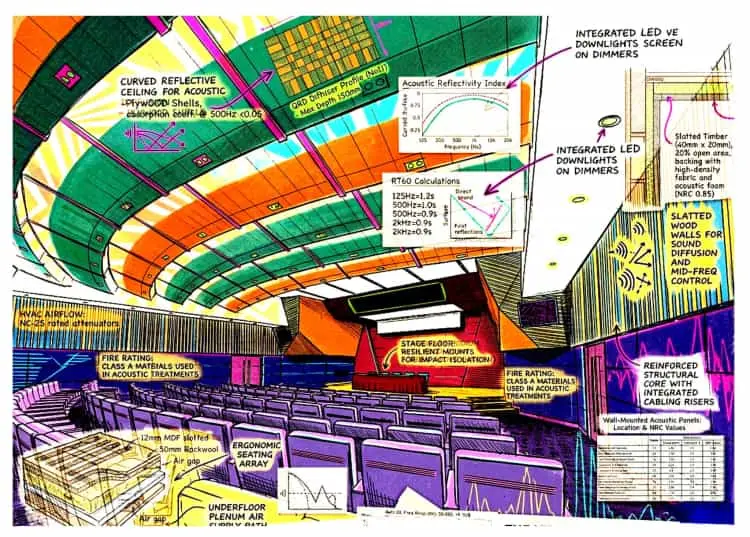
Introduction: What Auditorium Acoustic Design Really Demands
As architects, we are trained to think in volumes, in proportions, in the movement of light across a surface. We speak in plans and sections, in ratios and rhythms. There is a particular confidence — sometimes unconscious — that comes from wielding those instruments. We have a language for space, and we use it fluently.
But the moment you step into an auditorium project, something shifts. The scale doesn’t grow in the way you expect it to. It doesn’t expand outward into grandeur. Instead, it contracts inward — into the smallest possible unit of attention.
Suddenly, it is a joint line that matters. A panel edge. The density of a material you cannot even see. It is humbling in the most precise sense of the word — the project asks you to stop performing architecture and start listening to it.
And acoustics, most of all, does not forgive.
Part One: Why Auditorium Acoustic Design Is a Systems Problem, Not a Spatial One
1.1 The Shift from Volume to Detail in Professional Auditorium Design
An auditorium isn’t just a space you design. It’s a system you have to tune. You are not only shaping architecture — you are negotiating with sound, coordinating with systems, and constantly resolving material behaviour in real conditions.
Acoustics does not forgive in the way that other aspects of architecture might. A wall that is slightly off-colour can be repainted. A window that is marginally misaligned can be lived with. But sound is not accommodating in that way. It finds every gap, every hard surface that was left untreated, every structural connection that should have been decoupled. It reveals exactly what was built — not what was intended.
Furthermore, the acoustic performance of an auditorium emerges from the interaction of every element simultaneously: the geometry of the room, the absorption coefficients of each surface material, the reflective behaviour of panels, the isolation of the structure from external vibration, and the diffusion of sound across the listening plane. Consequently, a decision made about one element inevitably affects every other. Nothing is independent. Nothing is forgiving.
Understanding architectural acoustics at this level of integration is the foundational requirement for any serious auditorium design practice — not as a specialisation added to architectural thinking, but as the very language in which the architecture is conceived.
Table 1: Core Acoustic Design Parameters for Auditorium Projects
| Parameter | What It Governs | Typical Target Range | Consequence If Missed |
|---|---|---|---|
| RT60 (Reverberation Time) | Speech clarity vs. musical warmth | 1.4–2.2 s (music) / 0.8–1.2 s (speech) | Muddy sound or sterile, lifeless acoustic |
| STI (Speech Transmission Index) | Intelligibility of spoken word | ≥ 0.60 (good) / ≥ 0.75 (excellent) | Audience cannot follow speech or performance |
| NC / RC Level (Background Noise) | Mechanical noise intrusion | NC 20–30 (concert) / NC 25–35 (multi-use) | Audible HVAC competes with performers |
| STC of enclosing walls | External noise isolation | STC 55–70+ depending on adjacencies | Traffic, corridors, mechanical rooms bleed in |
| Panel absorption coefficient (NRC) | Surface-level sound control | Specified per frequency band, 63 Hz–8 kHz | Frequency imbalance distorts acoustic character |
| Diffusion coefficient | Even distribution of reflected energy | D ≥ 0.7 across 1–4 kHz | Hot spots, dead zones, uneven listening experience |
1.2 Six Critical Design Challenges Specific to Auditorium Acoustic Architecture
First and foremost, auditorium acoustic design is distinguished from general architectural practice by a specific set of compounding challenges that are rarely encountered elsewhere. Initially, these may appear to be technical problems — but experience reveals them to be fundamentally relational problems, arising at the boundaries between disciplines, between design stages, and between the drawing and the made object.
The six challenges that consistently define the difficulty of auditorium acoustic design are: managing low-frequency modal behaviour in large volumes; specifying material systems whose acoustic performance matches laboratory test conditions in real installation; controlling flanking transmission through structural connections that cannot easily be isolated; integrating HVAC systems that meet NC targets without compromising spatial quality; resolving the acoustic consequences of late design changes; and maintaining acoustic integrity through the substitution pressures that inevitably arise during procurement.
Part Two: The Design-to-Procurement Gap in Auditorium Projects — Where Acoustic Performance Is Won or Lost
2.1 How Procurement Timing Affects Acoustic Material Decisions & Construction Outcomes
Working across several auditorium projects, a pattern became difficult to ignore. Design would move forward with confidence — drawings developed, details resolved, materials identified. And then procurement would arrive as a separate conversation, happening downstream, as though it were a logistical appendix to the real work.
But the problems that emerged — the substitutions, the lead times, the material behaviours that only became visible during installation — were never late-stage problems. They were born in the details, right at the beginning, in the decisions that design had already made without fully understanding the consequences of making.
Specifically, the detail had been drawn. The material had been specified. But the conversation about whether that material could actually be produced, sourced, and installed to the tolerance that the drawing assumed — that conversation had not happened yet. And by the time it did, decisions were expensive to reverse.
Moreover, this is not a problem of individual oversight. It is structural. Design and manufacturing operate on different timelines, speak different technical languages, and hold different definitions of what precision means. Consequently, when they finally meet — typically during the procurement stage of construction documentation — the distance to close is significant, and the time available is short.
The sound absorption performance of a panel system, for instance, is specified by its absorption coefficient across a range of frequencies. That coefficient is determined not only by the material itself but by its thickness, its mounting method, the air gap behind it, and the tolerances of its installation. A substitution made during procurement — even a substitution of apparently similar material — can alter the frequency response of a surface in ways that meaningfully affect the room’s RT60. And by the time that consequence becomes audible, the surface is finished and the building is occupied.
Table 2: Common Procurement-Stage Substitutions & Their Acoustic Impact in Auditorium Construction
| Specified Element | Common Substitution | Acoustic Consequence | Risk Level |
|---|---|---|---|
| High-density mineral wool panel (80–100 kg/m³) | Standard density batt (40 kg/m³) | Reduced low-frequency absorption, RT60 rises at 125–250 Hz | High |
| Acoustic ceiling tile (NRC 0.90+) | Standard ceiling tile (NRC 0.55) | Significant reverberation increase across mid-high frequencies | Critical |
| Perforated facing panel (specific % open area) | Solid panel (cost saving) | Near-total loss of mid-frequency absorption behind panel | Critical |
| Resilient isolation mount (specified natural freq.) | Standard rubber pad | Structure-borne noise isolation degraded by 10–20 dB | High |
| Laminated acoustic glass (PVB interlayer) | Standard double-glazing | STC reduction of 8–12 dB at critical frequencies | High |
| Specified panel joint detail (acoustic sealant) | Dry-butted joint | Flanking transmission opens; effective STC drops 5–10 dB | Medium-High |
2.2 What Happens When Design and Making Speak Different Languages
That friction became a question. Not a theory — a practical, uncomfortable question that arose from repeated experience: what if procurement wasn’t something that followed design, but something that grew with it?
What if designers stayed closer to materials — not in an abstract, conceptual sense, but in the concrete sense of understanding how things are actually made? What does production look like for this panel? What are the real tolerances? What happens when the specified density is not available in the specified dimension, and a substitution has to be made on site?
That question pulled us into a different role. Not into manufacturing itself — but toward it. From designing, to getting involved in sourcing, to developing a working understanding of how the things we draw are actually produced. It was not a comfortable expansion. It required a different kind of attention, a different set of conversations, a willingness to be a beginner again in a domain where design usually arrives with authority.
Additionally, it required a different relationship with soundproofing and acoustic insulation suppliers — not as vendors fulfilling specifications but as collaborators holding knowledge that design needed earlier in the process.
Part Three: Building the Bridge — Integrating Acoustic Design, Material Sourcing & Construction Knowledge
3.1 A Design-Manufacture Integration Framework for Acoustic Auditorium Projects
What became clear through that process was that the gap was not merely technical. It was structural. Design and manufacturing were operating as two separate worlds — each with its own language, its own timeline, its own definition of what precision means.
The response was not to merge those worlds — they are genuinely different, and that difference has value. The response was to try to build a small bridge between them. Not a perfect system. Not a complete solution. Just a structure in which the relevant conversations could happen earlier — where detailing, material decisions, and the realities of execution were not treated as disconnected stages but as simultaneous, overlapping concerns.
Almost like a station — where multiple trains arrive, align, and move forward together. Not one route, not one pace. But a shared platform where the timing is coordinated, and the journey begins from the same place.
Notably, this integration is not only about preventing problems. It is about enabling better decisions. When a designer understands the manufacturing constraints of an acoustic panel system early enough, they can design the geometry of the room around those constraints — achieving better acoustic performance and simpler construction simultaneously. Conversely, when a manufacturer understands the acoustic intent behind a specification early enough, they can propose production solutions that the designer would not have known to ask for.
The broader implications of this integration are detailed in the architectural acoustic standards that govern auditorium performance — standards that only deliver their intended value when the specification chain connecting design intent to installed reality remains unbroken.
Table 3: Design-Procurement Integration — Stage-by-Stage Acoustic Decision Framework
| Project Stage | Without Integration | With Early Integration | Acoustic Benefit |
|---|---|---|---|
| Concept design | Acoustic targets set in isolation | Acoustic targets set with material availability confirmed | Targets are buildable from day one |
| Schematic design | Material systems assumed; tolerances unverified | Material systems discussed with manufacturers; tolerances confirmed | Detail strategy is realistic, not aspirational |
| Design development | Substitution risk embedded in specifications | Alternative materials pre-qualified acoustically | Substitutions have pre-assessed acoustic impact |
| Construction documents | Procurement discovers conflicts | Procurement confirms aligned specifications | No late-stage acoustic compromise |
| Construction | Substitutions resolved on site under pressure | Substitutions resolved in advance with acoustic verification | Installed performance matches designed performance |
| Commissioning | Acoustic deficiencies discovered post-handover | Performance verified against targets pre-handover | Less remediation, more confidence |
3.2 What Changes When Two Teams Work Closer Than Before
It has not been seamless. There were trials. Errors that required rework. Adjustments made mid-process when the expected and the actual diverged. Learning that came too late in one project and was carried forward into the next.
But over time, working on auditorium projects through this closer integration, something began to shift. Material decisions improved — not because they were better drawn, but because they were better informed. Control over outcomes increased — not because the design was more precise on paper, but because the path from drawing to installation was more fully understood. Less time was lost in translation between disciplines that had previously spoken to each other only at intervals.
Two teams. Two different disciplines. Now working closer than they had before. Not merged — still distinct, still with their own expertise and their own ways of thinking. But in closer proximity. In earlier conversation. With a shared investment in the question of how a thing is actually made.
Conclusion: In Auditorium Acoustic Design, the Drawing Is Only the Beginning
Ultimately, the auditorium taught us humility. It asked us to slow down at the moments when we were most confident. It revealed the distance between what is drawn and what is built — and it suggested that closing that distance is not a logistical problem. It is a design problem. One that begins, like all the best ones, with a willingness to ask a different question.
We are still learning. Still evolving. But the direction feels clear: stay closer to making. Stay closer to materials. Treat the moment of construction not as the end of design’s responsibility — but as the place where design’s real intention is finally, irreversibly, tested.
In spaces like auditoriums, design doesn’t end with drawings. It only begins when materials, sound, and making come together.
About Prodec Group
Prodec Group is a leading provider of professional architectural acoustics solutions for auditoriums, performance spaces, and institutional buildings. We work alongside architects, acoustic consultants, and contractors from early design through to construction — bridging the gap between acoustic design intent and installed performance.
Explore our range of sound absorption materials for auditorium wall and ceiling systems, including high-density mineral wool boards, perforated panel systems, fabric-wrapped acoustic panels, and bass treatment solutions.
Discover our soundproofing and acoustic insulation systems for auditorium enclosures, including resilient isolation mounts, Mass Loaded Vinyl barriers, acoustic drywall assemblies, and structural decoupling solutions.
Reference our database of architectural acoustic standards covering ISO 3382, SMPTE, IEC 60268, BB93, and other international benchmarks relevant to auditorium and performance space acoustic design.