
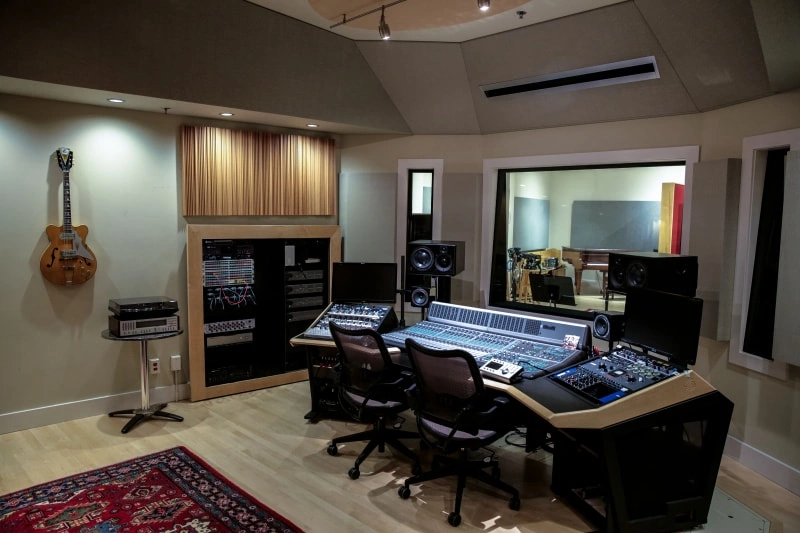
Introduction: The Science & Art of Professional Recording Studio Acoustics
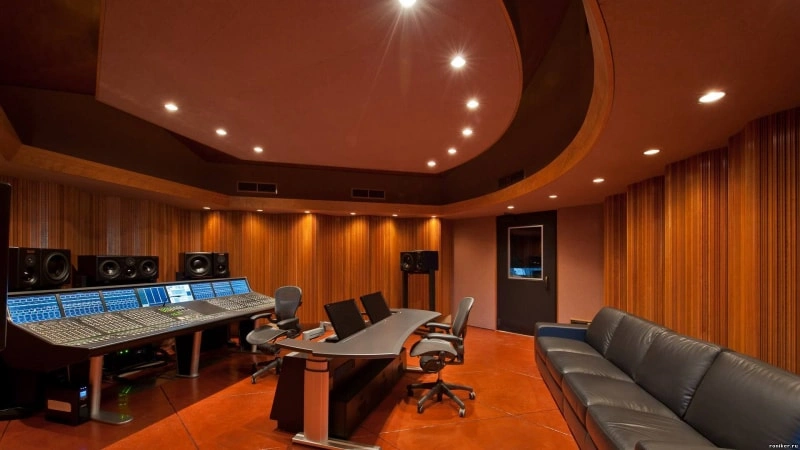
Recording studio acoustic design represents one of the most technically demanding and sonically critical disciplines within architectural acoustics, requiring exceptional precision in both acoustic treatment and sound isolation to create neutral, controlled environments enabling accurate audio production, mixing, and mastering. Unlike concert halls designed to enhance live performance or cinemas optimized for sound reproduction, recording studios must provide completely transparent acoustic conditions where engineers and producers can make critical decisions that will translate accurately across diverse playback systems worldwide.
Moreover, professional recording facilities encompass multiple specialized spaces—tracking rooms, control rooms, isolation booths, live rooms, and mastering suites—each with distinct acoustic requirements yet demanding seamless integration within a cohesive facility. Consequently, successful recording studio design necessitates comprehensive understanding of psychoacoustics, room mode behavior, sound absorption characteristics, isolation construction techniques, and critical listening environment optimization.
Furthermore, modern recording studios face evolving challenges including accommodating diverse musical genres from intimate acoustic performances to high-energy rock sessions, integrating sophisticated digital audio workstations with traditional analog equipment, meeting stringent environmental noise standards in urban locations, and achieving world-class acoustic performance within often-constrained budgets and building spaces. Therefore, this comprehensive guide examines recording studio acoustic design from fundamental principles through advanced implementation strategies, providing studio designers, acoustic consultants, audio engineers, and facility developers with authoritative guidance for creating professional-grade recording environments.
Part One: Recording Studio Acoustic Fundamentals & Critical Listening Environment Principles
1.1 Essential Acoustic Characteristics for Professional Audio Production Environments
Fundamentally, recording studio acoustics must satisfy three paramount objectives simultaneously. Initially, the acoustic environment must provide exceptionally flat, neutral frequency response enabling accurate monitoring and mix decisions that translate reliably to other playback systems. Subsequently, the space must exhibit appropriate temporal response characteristics including controlled early reflections and reverberation supporting critical listening without coloring the recorded sound. Finally, the facility must achieve complete isolation from external noise sources and between internal studio spaces, ensuring pristine recording conditions and preventing interference between simultaneous sessions.
Core Recording Studio Acoustic Objectives & Target Parameters
| Acoustic Objective | Physical Requirement | Perceived Quality | Primary Measurement | Professional Target | Critical Applications |
|---|---|---|---|---|---|
| Flat Frequency Response | Uniform absorption across spectrum | No tonal coloration | ±3 dB (40 Hz – 16 kHz) | ±2 dB ideal | Mixing, mastering |
| Controlled Reflections | Optimized early reflection pattern | Accurate stereo imaging | ITDG 15-25 ms | Critical precision | Stereo monitoring |
| Low Modal Density | Non-parallel surfaces, treatment | Even bass response | Modal spacing >5 Hz | Smooth low-end | Bass-critical work |
| Short Reverberation | High absorption, proper volume | Dry, controlled sound | RT60: 0.2-0.4 seconds | Genre-dependent | Control rooms |
| Exceptional Isolation | Mass, decoupling, sealing | Zero external intrusion | STC 70-85+ | Maximum achievable | All professional studios |
| Minimal Background Noise | Ultra-quiet HVAC, isolation | Silent monitoring environment | NC 10-15 | Quietest possible | Mastering, critical listening |
| Accurate Stereo Imaging | Symmetrical room, reflection control | Precise localization | Image width/depth | Excellent definition | Mixing, production |
1.2 Nine Critical Design Challenges in Professional Recording Studio Development
Achieving True Acoustic Neutrality: First and foremost, recording studios must avoid imparting any sonic character or coloration to monitored audio. However, all physical spaces possess inherent acoustic signatures through resonances, reflections, and absorption characteristics. Consequently, achieving genuine acoustic transparency requires extraordinary attention to room proportions, surface treatment, and modal control.
Managing Low-Frequency Room Modes: Subsequently, room modes (standing waves) at frequencies below 300 Hz create peaks and nulls in frequency response dramatically affecting bass perception and mix decisions. Moreover, small to medium-sized rooms suffer particularly severe modal problems due to limited mode density and spatial averaging. Therefore, room proportion optimization, strategic bass absorption placement, and sometimes active bass management become essential.
Controlling Early Reflection Patterns: Additionally, early reflections arriving within 15-40 milliseconds after direct sound profoundly influence stereo imaging, tonal balance, and mix accuracy. Specifically, reflections from side walls, ceiling, and console surfaces can blur stereo image, create comb filtering, and compromise mix translation. Thus, precise reflection point treatment and reflection-free zone design prove critical.
Providing Appropriate Reverberation for Different Spaces: Moreover, control rooms require very short reverberation (0.2-0.3s) for analytical listening, whereas tracking rooms benefit from moderate reverberation (0.4-0.6s) supporting musical performance without excessive liveness. Furthermore, some facilities incorporate variable acoustics enabling adjustment between dry and ambient characteristics.
Achieving Extreme Sound Isolation: Furthermore, professional recording demands isolation levels far exceeding typical architectural standards. Specifically, STC ratings of 70-85+ become necessary to prevent external noise intrusion in urban locations and enable simultaneous recording and mixing in adjacent spaces without crosstalk. Consequently, room-within-room construction, floating floors, isolated ceilings, and meticulous sealing prove essential.
Eliminating HVAC and Equipment Noise: Similarly, background noise from HVAC systems, computer equipment, lighting fixtures, and building services must be reduced to NC 10-15 or lower for critical listening and mastering applications. Indeed, noise levels imperceptible in normal conversation can seriously compromise recording quality and mixing accuracy.
Creating Optimal Monitor Positioning and Acoustics: In addition, loudspeaker placement relative to walls, ceiling, and listening position dramatically affects frequency response and stereo imaging. However, practical constraints including console size, room dimensions, and door locations often conflict with ideal acoustic positioning. Therefore, careful acoustic design must compensate for compromised placement through strategic treatment and room optimization.
Balancing Absorption and Liveness: Moreover, excessive absorption creates acoustically dead spaces causing listening fatigue and unnatural sound, while insufficient absorption produces flutter echoes, excessive reverberation, and compromised accuracy. Consequently, achieving appropriate balance requires sophisticated understanding of absorption characteristics, placement strategies, and human perception.
Integrating Multiple Specialized Spaces: Finally, complete recording facilities incorporate control rooms, tracking rooms, isolation booths, live rooms, and sometimes mastering suites, each requiring distinct acoustic characteristics yet demanding acoustic isolation from adjacent spaces. Therefore, facility layout, structural isolation, and acoustic door placement require comprehensive planning ensuring all spaces function optimally without mutual interference.
Obtain Your Exclusive Acoustic Solution
Part Two: International Standards & Industry Best Practices for Recording Facilities
2.1 Key Standards & Guidelines for Recording Studio Acoustic Design
Primary Standards & Authoritative References for Studio Design
| Standard/Reference | Issuing Organization | Primary Focus | Key Requirements | Design Applications |
|---|---|---|---|---|
| ITU-R BS.1116-3 | International Telecommunication Union | Critical listening rooms | Monitor placement, room dimensions, acoustic treatment | Mixing, mastering suites |
| IEC 60268-13 | International Electrotechnical Commission | Listening room acoustics | Frequency response, reverberation time | Control room design |
| EBU Tech 3276 | European Broadcasting Union | Listening conditions | Room acoustics, monitoring standards | Broadcast facilities |
| SMPTE 202 | Society of Motion Picture & Television Engineers | Dubbing stages, review rooms | Background noise, isolation, RT60 | Post-production studios |
| BBC Research White Paper | British Broadcasting Corporation | Studio acoustic design | Comprehensive design guidance | All studio types |
| AES Standards | Audio Engineering Society | Various audio topics | Industry consensus practices | Professional audio facilities |
2.2 Control Room Design Standards: ITU & IEC Requirements
Notably, ITU-R BS.1116-3 provides the most authoritative guidance for critical listening room design, establishing requirements for multichannel stereophonic sound systems and listening environments.
ITU-R BS.1116-3 Critical Listening Room Requirements
| Parameter | Requirement | Measurement Method | Tolerance | Purpose |
|---|---|---|---|---|
| Room Volume | 30-150 m³ recommended | Direct measurement | Functional range | Adequate modal density |
| Reverberation Time | 0.2-0.4 s (200-4000 Hz) | ISO 3382 | ±20% | Controlled acoustic |
| Background Noise | NR 10 or less | ISO 1996-2 | No exceedance | Silent monitoring |
| Frequency Response | ±2 dB (40 Hz – 16 kHz) | 1/3 octave measurement | At listening position | Flat response |
| Modal Spacing | >5 Hz recommended | Calculation/measurement | Below 200 Hz | Smooth bass |
| Reflection Management | Controlled early reflections | Time-domain analysis | Critical angles | Accurate imaging |
2.3 Recording Studio Classification & Performance Tiers
Recording Studio Classification by Acoustic Performance Level
| Studio Tier | Background Noise | Isolation (STC) | Frequency Response | RT60 Control Room | Typical Clients | Investment Level |
|---|---|---|---|---|---|---|
| World-Class Mastering | NC 5-10 | STC 80-85+ | ±1 dB (30-20k Hz) | 0.15-0.25 s | Major labels, top artists | Premium |
| Professional A-Room | NC 10-15 | STC 75-80 | ±2 dB (40-16k Hz) | 0.20-0.30 s | Professional recording, mixing | High |
| Professional B-Room | NC 15-20 | STC 70-75 | ±3 dB (40-16k Hz) | 0.25-0.35 s | Project studios, production | Moderate-High |
| Project/Home Studio | NC 20-25 | STC 60-70 | ±4 dB (50-16k Hz) | 0.30-0.40 s | Independent artists, demos | Moderate |
| Budget/Educational | NC 25-30 | STC 50-60 | ±5 dB (50-12k Hz) | 0.35-0.45 s | Education, hobbyists | Low-Moderate |
Part Three: Control Room Acoustic Design & Critical Listening Optimization
3.1 Room Proportions & Dimensional Relationships for Optimal Modal Distribution
Initially, control room dimensions profoundly influence low-frequency modal behavior, with certain dimensional ratios producing more evenly distributed modes supporting smoother bass response.
Recommended Control Room Dimensional Ratios & Modal Analysis
| Room Proportion System | Height : Width : Length | Modal Distribution Quality | Bass Smoothness | Practical Constraints |
|---|---|---|---|---|
| Louden Ratio | 1 : 1.4 : 1.9 | Good | Good | Widely validated |
| Cox Ratio | 1 : 1.6 : 2.3 | Very Good | Very Good | Requires larger space |
| Bonello Criteria | Variable (calculated) | Excellent | Excellent | Complex calculation |
| IEC 268-13 Range | 1 : 1.1-1.5 : 1.4-2.1 | Good range | Variable | Flexible guideline |
| Golden Ratio | 1 : 1.618 : 2.618 | Good | Good | Aesthetically pleasing |
| Non-Rectangular | Custom geometry | Can be excellent | Requires modeling | Advanced design |
Critical Room Dimension Guidelines:
- Minimum control room height: 2.4 meters (adequate headroom)
- Optimal height range: 2.6-3.2 meters (better modal density)
- Width: 3.5-5.5 meters typical (stereo monitoring distance)
- Length: 5.0-8.0 meters typical (adequate distance from monitors)
- Volume: 30-80 m³ ideal for stereo monitoring rooms
3.2 Monitor Placement & Acoustic Optimization Strategies
Subsequently, loudspeaker positioning relative to room boundaries and listening position critically affects frequency response, particularly in the bass region where boundary interference creates significant response variations.
Monitor Placement Guidelines & Boundary Distance Effects
| Placement Parameter | Recommended Value | Acoustic Rationale | Bass Response Impact | Imaging Effect |
|---|---|---|---|---|
| Front Wall Distance | 0.8-1.5 meters minimum | Reduces SBIR (Speaker Boundary Interference Response) | Minimizes comb filtering | Improved depth |
| Side Wall Distance | 0.6-1.2 meters minimum | Reduces lateral reflections | Less side wall coupling | Better imaging |
| Listening Distance | 1.5-3.0 meters typical | Adequate stereo triangle | Direct sound dominance | Optimal imaging |
| Stereo Angle | 60° included angle | ITU recommendation | Minimal impact | Accurate imaging |
| Monitor Height | Tweeter at ear level | Vertical dispersion control | HF accuracy | Proper tonal balance |
| Symmetry | Perfect left-right symmetry | Identical path lengths | Balanced bass | Centered image |
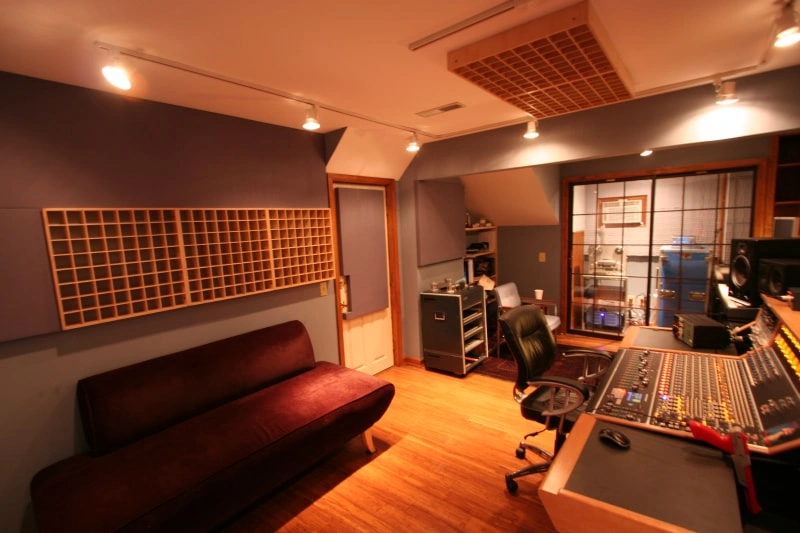
3.3 Reflection-Free Zone (RFZ) Design & Implementation
Moreover, the Reflection-Free Zone concept, pioneered by acoustic designer Tom Hidley, eliminates early reflections from critical surfaces surrounding the mix position, dramatically improving stereo imaging and mix accuracy.
Reflection Point Treatment Strategies
| Reflection Surface | Treatment Type | NRC Target | Typical Materials | Acoustic Function |
|---|---|---|---|---|
| Side Wall Reflection Points | Highly Absorptive | 0.90-1.00 | Thick fiberglass panels, bass traps | Eliminate lateral reflections |
| Ceiling Reflection Point | Absorptive or Diffusive | 0.70-0.90 | Acoustic panels, cloud absorbers | Control overhead reflections |
| Rear Wall | Diffusive preferred | 0.30-0.50 (diffusive) | Quadratic diffusers, skyline | Maintain liveness, prevent flutter |
| Floor | Variable absorption | 0.10-0.30 | Carpet, wood, concrete | Depends on overall strategy |
| Console/Desk Surface | Absorptive edge treatment | Local treatment | Foam, fabric | Reduce console reflections |
3.4 Bass Management & Low-Frequency Room Mode Control
Furthermore, controlling low-frequency room modes represents one of the most challenging aspects of small room acoustics, requiring multi-faceted approaches including strategic placement, absorption, and sometimes electronic correction.
Low-Frequency Control Strategies & Effectiveness
| Strategy | Frequency Range | Effectiveness | Implementation Complexity | Cost Factor | Limitations |
|---|---|---|---|---|---|
| Room Proportion Optimization | All bass frequencies | Moderate | Design phase only | None | Limited by practical constraints |
| Strategic Monitor/Listening Position | 30-150 Hz | Moderate-High | Moderate | Low | Trial-and-error required |
| Corner Bass Traps | 40-150 Hz | High | Moderate | Moderate | Requires corner access |
| Membrane/Panel Absorbers | 30-80 Hz | Very High | High | Moderate-High | Narrow bandwidth, tuning required |
| Distributed Bass Absorption | 40-200 Hz | High | Moderate | Moderate-High | Requires extensive coverage |
| Multiple Subwoofer Systems | 20-100 Hz | High | High | High | Requires calibration, DSP |
| Active Room Correction (DSP) | 20-200 Hz | Moderate-High | Moderate | Low-Moderate | Cannot fix time-domain issues |
Bass Trap Design Principles:
- Corner placement maximizes effectiveness (maximum pressure zone)
- Thickness matters: 300-600mm minimum for sub-100 Hz absorption
- Porous absorbers: require extreme thickness for low frequencies
- Resonant absorbers: tuned panels or membranes for specific frequencies
- Hybrid designs: combine multiple absorption mechanisms
Part Four: Tracking Room & Live Room Acoustic Design
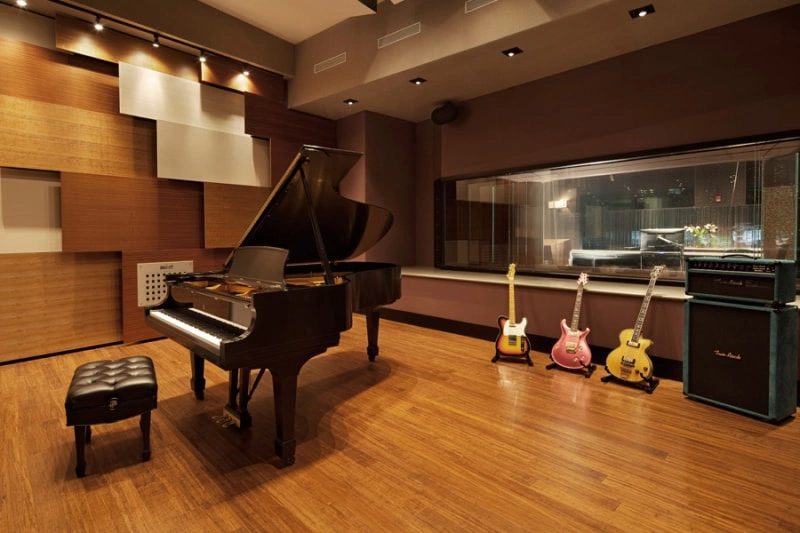
4.1 Live Room Acoustic Characteristics for Different Musical Genres
Conversely, tracking rooms and live rooms intentionally provide acoustic ambience supporting musical performance, with optimal characteristics varying significantly by musical genre and recording approach.
Tracking Room Acoustic Targets by Musical Genre
| Musical Genre | Optimal RT60 | Room Volume | Acoustic Character | Wall Treatment | Ceiling Treatment |
|---|---|---|---|---|---|
| Rock/Pop Drums | 0.4-0.6 s | 60-150 m³ | Moderately live, punchy | Mixed reflective/absorptive | Reflective with diffusion |
| Jazz/Acoustic | 0.5-0.8 s | 80-200 m³ | Natural ambience | Mostly reflective with absorption | Reflective, some absorption |
| Classical/Chamber | 0.8-1.2 s | 150-400 m³ | Concert hall character | Primarily reflective | High, reflective |
| Voice/Dialogue | 0.2-0.4 s | 15-40 m³ | Very dry, controlled | Highly absorptive | Absorptive treatment |
| Strings | 0.6-1.0 s | 100-250 m³ | Warm, supportive | Balanced approach | Moderately reflective |
| Heavy Music | 0.3-0.5 s | 60-120 m³ | Tight, controlled | Significant absorption | Mixed treatment |
4.2 Variable Acoustic Systems for Multi-Genre Recording Facilities
Additionally, professional studios serving diverse clients benefit from adjustable acoustic environments enabling optimization for different recording approaches.
Variable Acoustic Technologies for Recording Studios
| Technology | Adjustment Range | Response Time | Reliability | Cost | Maintenance | Optimal Applications |
|---|---|---|---|---|---|---|
| Rotating Panels | ±0.2-0.4 s RT | 1-2 minutes | High | High | Low | High-end studios |
| Retractable Curtains | ±0.3-0.5 s RT | 2-5 minutes | Moderate | Moderate | Moderate | Multi-room facilities |
| Hinged Absorbers | ±0.2-0.3 s RT | <1 minute | Very High | Moderate | Very Low | Vocal booths, small rooms |
| Modular Panels | Variable | 5-15 minutes | High | Low-Moderate | Low | Project studios |
| Movable Gobos | Local control | Immediate | Very High | Low | Very Low | All tracking rooms |
Part Five: Sound Isolation Design & Construction Techniques
5.1 Room-Within-Room Construction: The Gold Standard for Studio Isolation
Primarily, room-within-room construction provides ultimate sound isolation by creating completely independent inner structures mechanically isolated from outer buildings.
Sound Isolation Construction Methods & Performance Comparison
| Construction Method | Typical STC | Cost Factor | Complexity | Space Loss | Applications | Key Advantages |
|---|---|---|---|---|---|---|
| Single Stud Wall + Insulation | STC 45-50 | 1.0x | Low | Minimal | Not recommended for studios | Inadequate isolation |
| Double Stud Wall | STC 60-65 | 1.8x | Moderate | 200-250mm | Budget studios | Good cost/performance |
| Staggered Stud Wall | STC 65-70 | 2.0x | Moderate | 150-200mm | Project studios | Efficient use of space |
| Isolated Double Wall | STC 70-75 | 2.5x | High | 250-350mm | Professional studios | Excellent isolation |
| Room-in-Room (Partial) | STC 75-80 | 3.0x | High | 300-500mm | High-end facilities | Very high performance |
| Room-in-Room (Complete) | STC 80-85+ | 4.0-5.0x | Very High | 400-600mm | Mastering, world-class | Maximum isolation |
Critical Construction Details for Maximum Isolation:
- No rigid connections: Inner and outer structures must be completely mechanically isolated
- Floating floors: Resilient isolation pads or spring systems supporting entire floor assembly
- Isolated ceilings: Ceiling structure attached only to inner walls, never touching outer structure
- Mass-Air-Mass principle: Multiple heavy layers with air gaps provide superior isolation
- Comprehensive sealing: Even small gaps dramatically reduce isolation effectiveness
- Resilient mounting: All penetrations (electrical, HVAC) must use isolated mounting methods
5.2 Door & Window Acoustic Sealing: Critical Weak Points in Isolation
Subsequently, doors and windows represent the weakest elements in otherwise high-performance isolation assemblies, requiring specialized solutions.
Acoustic Door & Window Solutions
| Component Type | Typical STC | Configuration | Applications | Critical Features | Cost Factor |
|---|---|---|---|---|---|
| Standard Solid Core Door | STC 30-35 | Single leaf | Interior access only | Inadequate for studios | Low |
| Acoustic Rated Door | STC 45-50 | Single leaf, gasketed | Non-critical separations | Perimeter seals, drop seal | Moderate |
| Double Door with Vestibule | STC 60-65 | Two leaves, air gap | Professional studios | Sound lock entry | High |
| Studio-Grade Door | STC 65-70 | Specialized construction | High-isolation rooms | Heavy core, multi-seal | Very High |
| Double Glazed Window | STC 35-40 | Two panes, standard spacing | Visual access, low isolation | Not suitable for studios | Moderate |
| Laminated Glass Window | STC 40-45 | Laminated construction | Moderate isolation needs | Better than standard | Moderate-High |
| Studio-Grade Double Window | STC 55-60 | Large air gap, laminated glass | Professional studios | 150-300mm gap, different thicknesses | High |
| Triple-Pane Studio Window | STC 60-65+ | Three panes, isolated frame | Premium isolation | Maximum performance | Very High |
5.3 Floor Isolation Systems: Eliminating Structure-Borne Noise Transmission
Moreover, floating floor construction prevents vibration and impact noise transmission through building structures, essential for multi-story studios or facilities with sensitive neighbors.
Floating Floor Systems & Performance Characteristics
| Floor System | Typical IIC | Typical STC | Resonant Frequency | Deflection | Cost Factor | Applications |
|---|---|---|---|---|---|---|
| Neoprene Pads | IIC 55-60 | STC 60-65 | 18-25 Hz | 3-5 mm | Moderate | Standard studios |
| Cork/Rubber Underlayment | IIC 50-55 | STC 55-60 | 20-30 Hz | 2-4 mm | Low-Moderate | Budget studios |
| Engineered Resilient Mounts | IIC 65-70 | STC 70-75 | 10-15 Hz | 5-10 mm | High | Professional studios |
| Steel Spring Isolators | IIC 70-75 | STC 75-80 | 5-8 Hz | 10-25 mm | Very High | Mastering, critical spaces |
| Air Spring Systems | IIC 75-80+ | STC 80-85+ | 2-4 Hz | 15-40 mm | Premium | World-class facilities |
Part Six: HVAC System Design for Ultra-Quiet Recording Environments
6.1 Silent Ventilation: The Most Challenging Aspect of Studio Design
Importantly, achieving NC 10-15 background noise while providing adequate ventilation represents one of the most technically demanding aspects of recording studio design.
Table 14: HVAC Noise Control Strategy Hierarchy for Recording Studios
| Control Tier | Strategy | Target Contribution | Implementation | Effectiveness | Complexity |
|---|---|---|---|---|---|
| Tier 1 – Source | Ultra-quiet equipment | <NC 5 | Oversized, variable speed, premium equipment | Critical | High |
| Tier 2 – Velocity | Extremely low air speed | <NC 3 | Very large ducts, <2 m/s velocity | Critical | Very High |
| Tier 3 – Attenuation | Multiple silencers | 35-45 dB insertion loss | Custom silencer design, extended length | Essential | High |
| Tier 4 – Isolation | Complete vibration isolation | Eliminate structure-borne | Spring mounts, flexible connections | Essential | Moderate |
| Tier 5 – Duct Treatment | Acoustic lining | 10-15 dB reduction | Full-length internal lining | Important | Moderate |
| Tier 6 – Terminal | Silent diffusers | <NC 2 | Custom low-velocity diffusers | Important | Moderate |
| Tier 7 – Plenum | Pressure/velocity management | Smooth flow | Oversized plenums, transitions | Important | Moderate |
Critical HVAC Design Parameters for Recording Studios:
- Maximum air velocity: 1.5-2.0 m/s in main distribution
- Terminal velocity: <1.0 m/s at diffusers and returns
- Silencer performance: 40+ dB insertion loss at problem frequencies (125-500 Hz)
- Equipment location: Completely isolated mechanical rooms, maximum distance from studios
- Duct routing: Avoid straight paths from equipment to studios, use multiple direction changes
- Vibration isolation: Spring isolators with >95% efficiency at operating frequencies
6.2 Alternative Ventilation Strategies for Ultimate Quiet
Alternative HVAC Approaches for Critical Listening Spaces
| Approach | Noise Performance | Ventilation Effectiveness | Complexity | Cost | Optimal Applications |
|---|---|---|---|---|---|
| Intermittent Operation | NC 0 (when off) | Poor (periodic only) | Low | Low | Mastering suites, overdubs |
| Displacement Ventilation | NC 8-12 | Excellent | High | Very High | Large control rooms |
| Radiant Cooling + Minimal Air | NC 10-15 | Moderate | Very High | Premium | High-end mastering |
| Dedicated Outdoor Air + Local Treatment | NC 12-18 | Good | High | High | Professional studios |
| Thermal Mass + Night Cooling | NC 0 (during sessions) | Moderate | Moderate | Moderate | Appropriate climates |
Part Seven: Isolation Booth & Vocal Room Design
7.1 Dedicated Vocal Booth Acoustic Optimization
Additionally, isolation booths for vocal recording require carefully balanced acoustics providing enough liveness for performer comfort while maintaining sufficient dryness for post-production flexibility.
Vocal Booth Design Parameters & Recommendations
| Design Aspect | Recommended Value | Acoustic Rationale | Common Mistakes to Avoid |
|---|---|---|---|
| Minimum Volume | 8-15 m³ | Adequate air, avoids claustrophobia | Too small = uncomfortable, boxy |
| RT60 | 0.2-0.3 seconds | Dry but not dead | Over-damping causes fatigue |
| Ceiling Height | 2.4-3.0 meters | Adequate headroom, reduces modes | Too low = oppressive |
| Wall Treatment | Mixed absorption/diffusion | Controlled reflections | All absorption = dead |
| Floor | Hard surface or low pile carpet | Reduces boominess | Deep carpet = unnatural |
| Isolation | STC 60-70 minimum | Prevents bleed | Inadequate isolation common |
| Ventilation | Silent, adequate CFM | Comfort during takes | Noisy HVAC ruins recordings |
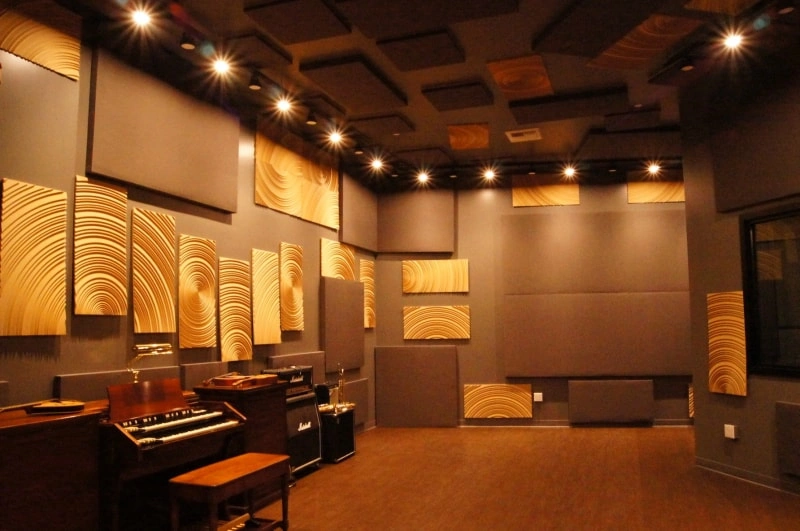
Part Eight: Acoustic Treatment Materials & Application Strategies
8.1 Porous Absorbers: Characteristics & Selection Criteria
Porous Absorptive Materials for Recording Studios
| Material Type | NRC Range | Thickness Required | Frequency Performance | Fire Rating | Applications | Cost |
|---|---|---|---|---|---|---|
| Fiberglass Panels | 0.80-1.00 | 50-150mm | Excellent mid-high | Class A | Broadband absorption | Low-Mod |
| Mineral Wool | 0.75-0.95 | 50-150mm | Excellent mid-high | Class A | Wall/ceiling treatment | Low-Mod |
| Acoustic Foam | 0.40-0.70 | 25-100mm | Good mid-high only | Varies | Budget studios (not professional) | Low |
| Polyester Fiber Panels | 0.60-0.85 | 25-75mm | Good mid-high | Class A | Decorative treatment | Moderate |
| Fabric-Wrapped Panels | 0.70-0.90 | 50-100mm + facing | Excellent with proper core | Class A | Professional appearance | Mod-High |
8.2 Resonant Absorbers: Low-Frequency Control Solutions
Low-Frequency Absorption Technologies
| Absorber Type | Effective Frequency | Bandwidth | Tuning Required | Effectiveness | Space Required | Complexity |
|---|---|---|---|---|---|---|
| Membrane (Panel) Absorbers | 40-120 Hz | Narrow (1/3 octave) | Yes | Very High | 100-300mm depth | High |
| Helmholtz Resonators | 60-200 Hz | Very Narrow | Yes | High | Variable | Very High |
| Thick Porous Absorbers | 60-250 Hz | Moderate-Wide | No | Moderate-High | 300-600mm depth | Low |
| Slat/Slot Absorbers | 80-300 Hz | Moderate | Partial | Moderate | 100-200mm depth | Moderate |
| Diaphragmatic Bass Traps | 30-80 Hz | Narrow-Moderate | Yes | Very High | 200-500mm depth | High |
Part Nine: Mastering Suite Design: The Ultimate Critical Listening Environment
9.1 Mastering Room Requirements: Beyond Standard Studio Specifications
Notably, mastering suites demand the highest level of acoustic precision, requiring even stricter tolerances than mixing rooms due to the critical nature of final audio production decisions affecting all subsequent playback systems.
Mastering Suite vs. Mixing Room Acoustic Specifications
| Parameter | Mastering Suite | Mixing Room | Difference | Critical Rationale |
|---|---|---|---|---|
| Frequency Response | ±1 dB (30-20k Hz) | ±2 dB (40-16k Hz) | Tighter tolerance | Micro-adjustments must be accurate |
| Background Noise | NC 5-10 | NC 10-15 | 5+ NC points quieter | Hear subtle details, dynamics |
| RT60 | 0.15-0.25 seconds | 0.20-0.35 seconds | Shorter, tighter | Maximum analytical clarity |
| Isolation (STC) | 80-85+ | 70-80 | Higher isolation | Zero external intrusion tolerated |
| Stereo Imaging | Exceptionally precise | Very precise | Higher precision | Subtle stereo field adjustments |
| Modal Control | Extensively treated | Well treated | More comprehensive | Absolute bass accuracy required |
9.2 Mastering Room Construction & Treatment Strategies
Furthermore, achieving mastering-grade acoustic performance requires extraordinary attention to construction details, material selection, and treatment implementation.
Essential Mastering Suite Design Elements:
- Room-within-room construction with complete isolation
- Optimized dimensions per Bonello or Cox criteria
- Extensive bass trapping in all corners and wall-ceiling junctions
- Precision monitor mounting systems eliminating vibration coupling
- Hardwood flooring with area rugs for adjustable absorption
- Multiple absorption and diffusion zones strategically placed
- Isolated equipment racks preventing vibration transmission
- Ultra-quiet HVAC with ability to shut down during critical listening
Part Ten: Common Acoustic Problems & Professional Solutions
10.1 Troubleshooting Matrix: Symptoms, Causes & Remedies
Common Recording Studio Acoustic Issues & Solutions
| Problem | Symptoms | Root Causes | Diagnostic Method | Solutions | Prevention |
|---|---|---|---|---|---|
| Uneven Bass Response | Peaks/nulls, frequency-dependent | Room modes, inadequate treatment | RTA measurement, modal analysis | Strategic bass traps, repositioning | Optimal room ratios, early treatment |
| Poor Stereo Imaging | Blurred center, width issues | Early reflections, asymmetry | Impulse response, imaging tests | Reflection point treatment, symmetry correction | RFZ design from start |
| Excessive Reverberation | Muddy mixes, lack of clarity | Insufficient absorption | RT60 measurement | Add absorptive panels, balance treatment | Adequate initial treatment |
| Dead/Lifeless Sound | Listening fatigue, unnatural | Over-absorption, no diffusion | Subjective assessment, EDT | Add diffusion, reduce absorption | Balanced approach |
| Flutter Echo | Metallic ringing sound | Parallel hard surfaces | Clap test, impulse response | Absorb or diffuse surfaces | Non-parallel walls, treatment |
| External Noise Intrusion | Traffic, neighbors audible | Inadequate isolation | Noise level measurement | Enhance isolation, seal gaps | Proper construction from start |
| HVAC Noise | Rumble, hiss during quiet | High velocity, inadequate silencing | Spectrum analysis | Reduce velocity, add silencers | Proper system design |
10.2 Post-Construction Acoustic Optimization Techniques
Additionally, even well-designed studios often require fine-tuning after construction to achieve optimal performance through measurement-guided adjustments.
Systematic Optimization Process:
- Comprehensive Acoustic Measurement: Full frequency response, waterfall plots, RT60, impulse response
- Problem Identification: Modal issues, reflection problems, response anomalies
- Solution Prioritization: Address most significant issues first
- Incremental Treatment: Add acoustic treatment systematically, measuring after each change
- Monitor Positioning Optimization: Fine-tune placement based on measurements
- Final Verification: Comprehensive remeasurement confirming improvements
Part Eleven: Acoustic Measurement & Testing Protocols
11.1 Essential Measurement Equipment & Procedures
Acoustic Measurement Tools for Recording Studios
| Measurement Type | Required Equipment | Software | Typical Cost | Expertise Level | Applications |
|---|---|---|---|---|---|
| Basic RT60 | Measurement mic, audio interface | REW (free) | $200-500 | Beginner-Intermediate | Reverberation time verification |
| Frequency Response | Calibrated mic, interface | REW, Smaart | $500-1,500 | Intermediate | System tuning, room analysis |
| Waterfall/Decay | Quality mic, interface | REW, FuzzMeasure | $500-2,000 | Intermediate-Advanced | Modal analysis, decay characteristics |
| Impulse Response | Measurement mic, interface | REW, ARTA | $500-1,500 | Intermediate | Time-domain analysis |
| Sound Level/Spectrum | Precision SLM | Built-in or PC | $500-3,000 | Intermediate | Background noise, isolation testing |
| Professional Acoustic Survey | Complete measurement system | Proprietary software | $5,000-15,000 | Expert/Consultant | Comprehensive facility analysis |
11.2 Acceptance Testing & Performance Verification Standards
Recording Studio Acceptance Testing Protocol
| Test Category | Parameters Measured | Standard/Method | Test Positions | Acceptance Criteria | Documentation |
|---|---|---|---|---|---|
| Reverberation Time | RT60, T20, EDT | ISO 3382-2 | 6-12 positions | Within spec ±15% | Full report with graphs |
| Frequency Response | 1/3 octave, full range | IEC 60268-13 | Listening position(s) | Within tolerance for room class | Response curves |
| Background Noise | NC, NR, dBA, spectrum | ISO 1996-2 | Multiple positions | Below maximum target | Spectral data |
| Sound Isolation | STC, field testing | ASTM E336 | Critical partitions | Meet or exceed spec | Test reports |
| Stereo Imaging | Phantom image, width | Subjective + objective | Mix position | Excellent definition | Listening tests |
| Modal Analysis | Room modes, decay | Waterfall analysis | Multiple positions | Acceptable modal distribution | Waterfall plots |
Part Twelve: Budget Considerations & Cost-Performance Optimization
12.1 Studio Acoustic Investment: Cost vs. Performance Analysis
Recording Studio Budget Allocation by Component
| Component Category | Budget Studios | Professional Studios | World-Class Studios | ROI Impact | Cannot Compromise |
|---|---|---|---|---|---|
| Sound Isolation Construction | 30-40% | 35-45% | 40-50% | Critical | Yes – foundational |
| Acoustic Treatment Materials | 15-25% | 20-30% | 25-35% | Very High | Yes – core performance |
| HVAC System | 10-15% | 15-20% | 20-25% | High | Yes – background noise |
| Acoustic Doors/Windows | 8-12% | 10-15% | 12-18% | High | Partial – weak points |
| Flooring Systems | 5-10% | 8-12% | 10-15% | Moderate-High | Depends on location |
| Testing & Verification | 2-5% | 3-8% | 5-10% | Very High | No – validates investment |
| Design/Consulting Fees | 5-10% | 8-15% | 10-20% | Critical | No – prevents costly errors |
12.2 High-Impact, Cost-Effective Acoustic Improvements
Moreover, certain acoustic improvements provide exceptional return on investment, dramatically improving studio performance at relatively modest cost.
Top 10 High-ROI Acoustic Upgrades:
- Corner Bass Traps (High impact, moderate cost)
- First Reflection Point Treatment (Critical for imaging, low-moderate cost)
- Rear Wall Diffusion (Eliminates flutter, maintains liveness, moderate cost)
- Door Weatherstripping/Seals (Dramatically improves isolation, very low cost)
- Gap/Penetration Sealing (Acoustic sealant, very low cost, high impact)
- HVAC Velocity Reduction (Lower velocity = lower noise, moderate cost)
- Equipment Rack Isolation (Eliminates vibration coupling, low cost)
- Monitor Isolation Pads (Improves bass accuracy, low cost)
- Ceiling Absorption Treatment (Reduces reflections, moderate cost)
- Acoustic Measurement & Positioning Optimization (Optimizes existing elements, very low cost)
Part Thirteen: Future Trends & Emerging Technologies
13.1 Advanced Technologies Shaping Recording Studio Design
Emerging Acoustic Technologies for Recording Facilities
| Technology | Current Status | Potential Impact | Implementation Timeline | Cost Implications |
|---|---|---|---|---|
| Active Acoustic Control | Commercial availability | Modal control, noise cancellation | Immediate | Moderate-High |
| Smart Acoustic Materials | Research/development | Tunable absorption, adaptive acoustics | 3-5 years | High |
| AI-Driven Room Correction | Early adoption | Automatic optimization | Immediate-2 years | Low-Moderate |
| Virtual Acoustic Modeling | Mature technology | Pre-construction validation | Immediate | Low-Moderate |
| 3D-Printed Acoustic Elements | Emerging | Custom diffusers, complex geometries | Immediate-2 years | Moderate |
| Metamaterial Absorbers | Research phase | Ultra-thin low-frequency absorption | 5-10 years | Unknown |
13.2 Sustainable & Green Studio Design Practices
Furthermore, environmental responsibility increasingly influences recording studio design, requiring balance between acoustic performance and ecological impact.
Sustainable Studio Design Strategies:
- Recycled/Recyclable Acoustic Materials: Polyester fiber panels from recycled bottles
- Low-VOC Products: Formaldehyde-free insulation, low-emission adhesives
- Energy-Efficient HVAC: Variable-speed drives, heat recovery, optimal insulation
- LED Lighting: Eliminates transformer hum, reduces heat load
- Locally Sourced Materials: Reduces transportation environmental impact
- Adaptive Reuse: Converting existing structures rather than new construction
- Long-Term Durability: Quality construction extending facility lifespan
Conclusion: Achieving Recording Studio Acoustic Excellence Through Systematic Design
In conclusion, world-class recording studio acoustic design demands comprehensive integration of isolation engineering, room acoustic optimization, critical listening environment creation, and systems thinking. Specifically, success requires:
Scientific Foundation: Understanding room acoustics, modal behavior, absorption characteristics, and isolation principles per international standards
Systematic Approach: Prioritizing isolation first, then room acoustics, followed by fine-tuning and measurement verification
Quality Materials: Specifying proven acoustic treatment products and isolation systems rather than compromising on fundamentals
Professional Expertise: Engaging experienced acoustic consultants preventing costly mistakes and optimizing performance
Measurement Verification: Comprehensive testing validating design achievement and guiding optimization
Ultimately, exceptional recording studio acoustics enable audio professionals to make confident creative decisions translating accurately across playback systems, justifying the investment through enhanced productivity, client satisfaction, and competitive advantage in the professional audio marketplace.